
Search
Remove Ads
Advertisement
Search Results

Video
Historical Complex of Split with the Palace of ... (UNESCO/NHK)
The ruins of Diocletian's Palace, built between the late 3rd and the early 4th centuries A.D., can be found throughout the city. The cathedral was built in the Middle Ages, reusing materials...

Definition
Bloody Sunday in 1905 - The Massacre at the Tsar's Winter Palace
Bloody Sunday on 22 January 1905 was the massacre of peaceful and unarmed protestors by soldiers outside the Winter Palace in St. Petersburg, Russia. The crowd of workers and their families...

Definition
Constantinople
Built in the seventh century BCE, the ancient city of Byzantium proved to be a valuable city for both the Greeks and Romans. Because it lay on the European side of the Strait of Bosporus, the Emperor Constantine understood its...

Article
Constantine’s Conversion to Christianity
Constantine I (Flavius Valerius Constantinus) was Roman emperor from 306-337 CE and is known to history as Constantine the Great for his conversion to Christianity in 312 CE and his subsequent Christianization...

Definition
Knossos
Knossos (pronounced Kuh-nuh-SOS) is the ancient Minoan palace and surrounding city on the island of Crete, sung of by Homer in his Odyssey: “Among their cities is the great city of Cnosus, where Minos reigned when nine years old, he...

Definition
Nijo Castle
Nijo Castle, located in Kyoto, Japan, was first built in 1603 CE by Tokugawa Ieyasu (r. 1603-1605 CE), founder of the Tokugawa Shogunate (1603-1868 CE). The castle complex is surrounded by a double moat and made up of three distinct...

Article
The Temple of Apollo at Didyma
Located about 11 miles south of the ancient port city of Miletus on the western coast of modern-day Turkey, the Temple of Apollo at Didyma or Didymaion was the fourth largest temple in the ancient Greek world. The...

Image
Herod's Palace, Caesarea Maritima
Among the many buildings and palaces that were built by Herod the Great throughout the city of Caesarea Maritima, perhaps reflecting his own grandiosity, the largest and most splendid palace would have been Herod's...

Definition
Roman Emperor
Roman emperors ruled the Roman Empire starting with Augustus in 27 BCE and continuing in the West until the late 5th century CE and in the Eastern Roman Empire up to the mid-15th century CE. The emperors took titles such as Caesar...
Image
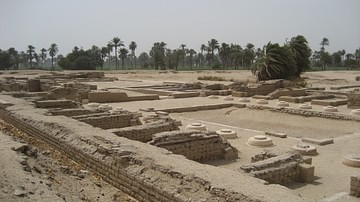
Amarna, Northern Palace
Northern Palace at Amarna. The royal family lived in apartments to the rear of the palace. The palace had no roof as a gesture of welcome to Aten.
