
Search
Remove Ads
Advertisement
Search Results

Image
Portrait of Diocletian
Portrait of Roman emperor Diocletian (284-305 CE) from Brest village, Pleven region, Bulgaria, late 3rd to early 4th century CE.
National Archaeological Museum, Sofia.

Definition
Storming of the Tuileries Palace
The Storming of the Tuileries Palace, also commonly known as the Insurrection of 10 August, was a defining moment in the French Revolution (1789-99) that saw the armed revolutionaries of Paris invade the residence...

Article
Archaeological Excavations at Tel Kabri
Tel Kabri is an archaeological site in northwestern Israel that is best known as the location of one of the largest palaces in Canaan in the Middle Bronze Age or "MB" (ca. 2,000–1,500 BCE). Although Tel Kabri...

Article
The Great Palace of Constantinople
The Great Palace of Constantinople was the magnificent residence of Byzantine emperors and their court officials which included a golden throne room with wondrous mechanical devices, reception halls, chapels, treasury...
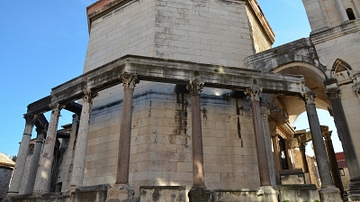
Image
Diocletian's Mausoleum
The octagonal mausoleum of Diocletian (now Cathedral of St. Domnius) inside Diocletian's Palace, Split (Croatia). Diocletian's Palace was built between 293-303 CE in preparation for his retirement on 1 May 305 CE.

Definition
Hisham's Palace
Hisham's Palace at Khirbat al-Mafjar (the ruins of Mafjar) is an Umayyad structure that is listed among the last of the surviving antiquities of Romans and Byzantines. It was built by Walid Ibn Yazid in 734 CE near Jericho in...

Definition
Tel Kabri
Tel Kabri is an archaeological site in the Western Galilee in northwestern Israel and the location of one of the largest palaces in Canaan in the Middle Bronze Age or "MB" (c. 2,000–1,500 BCE), the period in which Tel Kabri was at...

Image
Plan of the Baths of Diocletian
The floor plan of the Baths of Diocletian in Rome, completed in c. 305 CE.

Image
Roman Emperor Diocletian
Head of the Roman emperor Diocletian, 284 - 305 CE (Istanbul Archaeology Museum).

Article
Wall Reliefs: Ashurnasirpal II's War Scenes at the British Museum
The Mighty King 600 of their warriors I put to the sword and decapitated; 400 I took alive; 3,000 captives I brought forth; I took possession of the city for myself: the living soldiers...
