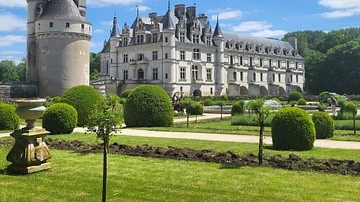


The Château d'Amboise, located in the Loire Valley, in central France, was built over several centuries and was the centre of royal power during the Renaissance (from the 15th to the early 17th century). Witness to the heyday of the French monarchy, but also to great tragedies, the château welcomed such famous figures as Leonardo da Vinci (1452-1519), Chevalier d'Artagnan (c. 1611-1673), and Charles V, Holy Roman Emperor (1500-1558), to name but a few. Its architecture evolved over the centuries and reflects its eventful history.
Architectural Highlights
Located on a rocky spur overlooking the town and the royal river, the Loire, the site of the Château d'Amboise covers an area of approximately two hectares. Inhabited since Neolithic times, it was transformed into a defensive structure in the 4th century, and the first fortress was built there in the 5th century. Today, only a few parts of the former palace remain, but visitors can still admire the beauty of the Chapel of Saint Hubert, completely restored from 2021 to 2024, the Minimes Tower and the Heurtault Tower, the royal lodge, and the superb gardens.
Chapel of Saint Hubert
The entrance ramp leads directly to the Chapel of Saint Hubert on the left. This flamboyant Gothic chapel with a golden spire was built under Charles VIII (reign 1483-1498) and served as a chapel for his wife, Queen Anne of Brittany (1477-1514). Built in tuffeau stone, typical of the Loire Valley, it houses some beautiful stained glass windows. It is in this chapel that Leonardo da Vinci is buried. According to the tradition reported by historian Giorgio Vasari, he passed away in the very arms of King Francis I (r. 1515-1547). In 1930, his tomb was rebuilt by Italian sculptor Francesco La Monaca (1882-1937), and the medallion, created by sculptor Jean Cardot, was added in the 2000s.

The Royal Lodge
The Renaissance wing was also built during the reign of Charles VIII. In order to offer his queen new buildings worthy of her love, the king had a large part of the castle courtyard cleared away, and the earth dumped at the foot of the promontory helped drain part of the surrounding marshes. To finance his architectural ambitions, Charles raised new taxes, which enabled him to build not only new lodgings but also most of the buildings we can see today. In fact, 75% of Charles' castle still remain to this day. Historian André Castelot gives a brief description of the interior:
Thanks to the king's accounts that have been kept, we know that the interior walls, decorated with French lilies and Breton ermines, disappeared under a truly astonishing profusion of tapestries, some of which – such as those depicting the life of Moses, the Romance of the Rose or Esther and Ahasuerus – were composed of fragments measuring a total of one hundred and fifty French ells, or more than 175 metres in length.
(63)
The royal lodge now consists of three levels: the ground floor and first floor evoke the Renaissance period, and the second floor, which dates from the 19th century (the reign of Louis-Philippe I of France, 1830-1848). The tour will also take you through the guards' rooms, the guards' promenade with its balustrades overlooking the Loire, the great council chamber, the king's bedroom, and the Minimes Tower.

The Cavalier Towers
The Minimes Tower, overlooking the Loire, is a 21-metre-diameter building. It has a slightly sloping ramp that allowed horses and carts to access the terraces and gardens. Its counterpart, the Heurtault Tower, located to the north of the site, is 24 metre in diameter and also has a ramp to facilitate access to the castle from the town. With the Hundred Years' War (1337-1453) finally over, the defence of the site was no longer considered a priority, and practical and aesthetic architecture ended up taking precedence.
The Gardens
The gardens cover just over two hectares and are now divided into two distinct parts. The well-defined Naples Terrace was designed by Italian artist Dom Pacello da Mercogliano (1453-1534) at the request of Charles VIII. The other section is a more contemporary English-style landscape garden, conceived by King Louis Philippe I in the 19th century. As you stroll along the paths of this park, you may come face to face with the Carrara marble bust by Henri de Vauréal, representing the man who bore witness to the heyday of this royal estate, the genius artist Leonardo da Vinci.

An Eventful History
Throughout its long history, the Château of Amboise was shaped by many conflicts, scandals, and tragedies, but also by births and lavish receptions organised to entertain the kingdom's nobility, before gradually falling into disuse in favour of palaces more to the taste of subsequent sovereigns or located closer to Paris.
A source of conflict between local lords throughout the Middle Ages, King Charles VII of France (r. from 1422 to 1461) seized it in 1431, convinced by his chamberlain that the Duke of Amboise, and perhaps even Joan of Arc (c. 1412-1431), were plotting against him. It was his son, Louis XI of France (1423-1483), but above all his grandson Charles VIII, a native of Amboise, who gave the castle most of its renowned splendour. Louis XI transformed the original fortress into a royal residence with Gothic décor and had more spacious and better furnished lodgings built for his wife Charlotte of Savoy (c. 1441-1483), who gave birth to their son Charles of Valois there. Charles (the future Charles VIII) had a very sheltered, even reclusive childhood at the castle, safe from attacks, but above all from the plague, which was still threatening the country at the time.

Under the Auspices of Charles VIII
Years later, long after Louis XI's death, the young Charles returned there with his young wife Anne of Brittany and seems to have wanted to rid himself of the stifling atmosphere that had plagued his childhood. From 1492 to 1497, he had new buildings constructed, and, after a visit to Italy in 1495, he surrounded himself with Italian artists, furniture, and sumptuous fabrics to embellish not only the castle but also the gardens. "He wants to turn the castle into a town," the Italian ambassador is said to have remarked during a visit in 1493. The king was in a hurry: work continued even at night, by candlelight.
It was Charles who had the Minimes Tower built, a ramp accessible to horses that winds around a central core, and who commissioned the construction of the Heurtaut Tower (completed after his death) as well as the Chapel of Saint Hubert, built between 1491 and 1496.

Then, on 7 April 1498, Palm Sunday, as he was passing through a narrow passageway on his way to the room where a game of real tennis was being played, the king hit his forehead on the lintel of a door (which were very low at the time). He died several hours later from a cerebral haemorrhage. His Italian paradise was then plunged into mourning. With no direct heir, the castle passed to a cousin of his, Louis d'Orléans, who became King Louis XII of France in 1498. He halted all work at Amboise to devote himself to the Château de Blois, a mere 20 miles (35 km) away. He ceded Amboise to his cousin Louise de Savoie, who came to live there in 1501 with her children, Marguerite and Francis of Angoulême. The young Francis enjoyed a wonderful adolescence there, receiving an intellectual and sporting education.
Francis I & Amboise's Heyday
After becoming king, Francis I resided there from 1515 to 1519, and this was a golden age for the castle: he organised lavish parties where his guests, including Charles V, who visited in December 1539, were treated to all kinds of delights that went far beyond mere visual or culinary pleasures. It was at his invitation that, in 1516, Leonardo da Vinci moved to the Clos-Lucé manor, a few steps away from the castle (both connected by an impressive underground passage), and it was Francis I who arranged for Leonardo to be buried on the grounds of the royal castle, where he still rests today. Francis I completed the work begun by his predecessor. He carried out numerous improvements to the royal lodge, finishing the wing begun by Louis XII and decorating it with numerous sculptures of salamanders, his totem animal.

However, life was not always peaceful for Francis I in Amboise. In 1534, he had to face what became known as the Affair of the Placards. As Martin Luther's Protestant Reformation was gradually growing in popularity, during the night of 17 to 18 October 1534, anti-Catholic pamphlets were posted throughout the kingdom, right up to the door of the king's chambers in the royal castle. What the king considered to be offensive and seditious writings were an affront to his authority and hardened his stance against supporters of the Reformation, towards whom he had previously shown relative tolerance. Not only did he end up making a public profession of faith, but he also ordered a series of executions to punish this act of lèse-majesté (treason), which neither he nor his heirs would easily forget.
The Tumult of Amboise
In 1560, while the grandson of Francis I, the young Francis II of France (reign 1559-1560), was ruling the country after the accidental death of his father, Henry II of France (reign 1547-1559), during a tournament, a new danger threatened the tranquillity of the castle. A plot, known as the Amboise conspiracy or 'Tumult of Amboise', aimed at kidnapping the monarch. Francis II was married to Mary, Queen of Scots (1542-1587), and was under the influence of the very Catholic Guise family. However, the princes of the blood, Antoine de Bourbon and Louis I de Condé, who were staunch Protestants, wanted to regain control of power. Even Queen Elizabeth I of England (reign 1558-1603), head of the Anglican Church, is suspected of having provided financial support for the conspiracy, while John Calvin and the Anglican churches disavowed such an undertaking. They then asked Georges Barré de la Renaudie, a gentleman from the Périgord region, to do everything in his power to deliver a text to the king denouncing the tyranny of the Guise family and remove him from their harmful influence. On 17 March, 200 conspirators tried in vain to break into the castle. Historian Jean des Cars gives us a brief account of what happened next:
After a brief battle, the reformers were imprisoned or executed, and Renaudie's body was hung from a bridge. The repression was particularly violent: Huguenots [Protestants] were hanged from the castle's large wrought-iron balcony and battlements, or thrown into the Loire River in sacks after being beheaded and quartered. Only Condé, the instigator of the plot, escaped this grim 'ball of the hanged' that could be seen from the Minimes tower. The bodies of some Huguenots were even hung from the city walls, leaving the traumatised population in shock. Nearly 1,200 people were killed...
(75-76)

Francis II was safe, for the time being, but only for a short time. He died in December 1560 from a poorly treated ear infection while staying at the Hôtel Groslot in Orléans. It was in the castle that the Peace of Amboise would finally be signed in 1563 between Catherine de' Medici, Francis II's mother who was then acting as regent, and the Prince of Condé to end years of conflict and allow freedom of worship for the Protestant aristocracy.
Later History
The castle then gradually fell into oblivion, with subsequent monarchs preferring other residences such as the Château de Blois and the Louvre Palace in Paris. It passed from one owner to another and was even converted into a prison under Louis XIV of France (reign 1643-1715). After hosting such famous prisoners as the Cardinal of Bourbon and two of Henry IV of France's sons, Louis XIV sent there Nicolas Fouquet (1615-1680), his finance minister, who was escorted by none other than d'Artagnan (1611-1673), the famous companion of the Three Musketeers. Amboise would offer hospitality to other renowned prisoners, notably in 1848, the Algerian Emir Abdelkader (1808-1883), who had so forcefully resisted the French conquest of Algeria. The emir and his entourage transformed the atmosphere of the castle into one of a Muslim palace until 1852, when, following a public outcry against the prisoners' appalling living conditions and the dilapidated state of the buildings, and once he promised not to cause any more trouble for France, he was finally released. Today, his portrait, next to that of Louis XIV as a child, proudly adorns the main hall.

Since 1974, it is the Saint Louis Foundation, currently chaired by Jean d'Orléans (born in 1965), Count of Paris and heir presumptive to the French throne (if there were still one, of course), which continues the tireless restoration work and, with an annual budget of around € 300,000 (about $ 350,000), ensures that this gem of the Loire Valley still attracts thousands of tourists every year and may continue to shine in all its glory.