
Search Images
Browse Content (p. 310)

Image
The Scalper Scalped - Pawnees and Cheyennes
The Scalper Scalped - Pawnees and Cheyennes, oil on card mounted on paperboard by George Catlin, 1861/1869.
National Gallery of Art, Washington D.C.
Image
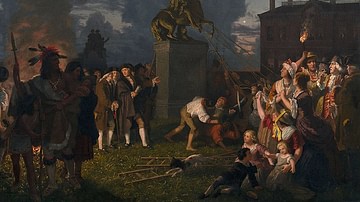
Pulling Down the Statue of King George III
On 9 July 1776, American Patriots and Sons of Liberty pull down the statue of King George III of Great Britain in New York City, shortly after George Washington read the United States Declaration of Independence. Two months later, the British...

Image
Battle of Long Island
Lord Stirling leads an attack against the British (in the background) to buy time for other American troops to retreat (as depicted in the foreground) at the Battle of Long Island (27 August 1776), which resulted in a defeat for the Continental...

Image
Sir William Howe
General Sir William Howe, commander of the British forces during the American Revolutionary War. Mezzotint by Richard Purcell, published by John Morris, London, November 1777. Anne S. K. Brown Military History Collection at Brown University...

Image
George Washington, 1776
George Washington as commander of the Continental Army, 1776. That year, which saw the defeat of Washington's army at the Battle of Long Island and in the subsequent New York Campaign of 1776 was the bleakest year of Washington's military...

Image
Delaware Regiment at the Battle of Long Island
The Delaware Regiment of the Continental Army at the Battle of Long Island during the American Revolutionary War. Painting by Domenick D'Andrea, commissioned by the US National Guard Bureau, c. 2004.

Image
Baruch Spinoza, Rijksmuseum
A posthumous portrait lithographic print of the Dutch philosopher Baruch Spinoza (1632-1677). (Rijksmuseum, Amsterdam)

Image
Grave of Baruch Spinoza
The grave of the Dutch philosopher Baruch Spinoza (1632-1677) at the Nieuwe Kerk in The Hague, Netherlands.
Image
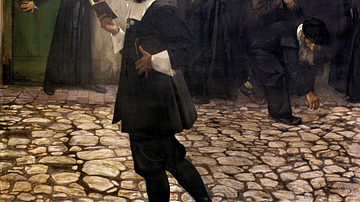
Excommunicated Spinoza
An early 20th-century painting by Samuel Hirszenberg of the Dutch philosopher Baruch Spinoza (1632-1677) illustrating his excomunication by the Jewish community in Amsterdam around 1656 for his radical views.
Image
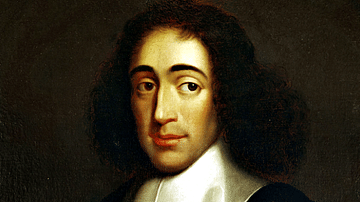
Portrait of Spinoza
A c. 1665 portrait of the Dutch philosopher Baruch Spinoza (1632-1677). (Herzog August Library, Wolfenbüttel, Germany)
