
Search Images
Browse Content (p. 1818)

Image
Roman Amphitheatre, Verona
The Roman amphitheatre of Verona, Italy, 1st century CE. The arena was the third largest in the Roman world and used to host gladiator, circus and equestrian events.
Image
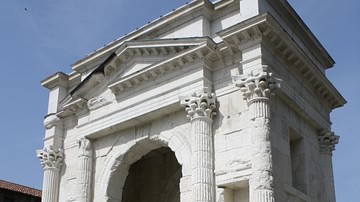
Arch of Gavi, Verona
The arch known as the Arco dei Gavi, Verona, Italy. Set up in the 1st century CE the arch glorfied the powerful Gavi family. Typically, arches commemorated military triumphs and statesmen but this is a rare example of such...

Image
Tutankhamun
A wooden bust of Tutankhamun (1345-1327 BCE), found in the pharaoh's tomb.
Cairo Museum, Egypt.

Image
Goddess Ishtar descent to the underworld tablet
The legend, written in Akkadian, describes how Ishtar, goddess of sexuality and warfare, went to the Underworld. Ishtar decided to undertake the journey, although the Underworld was known as the 'land...
Image
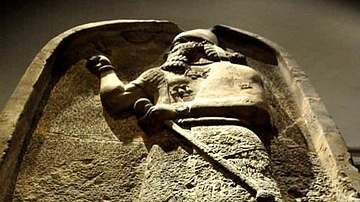
Gypsum Stela of Ashurnasirpal II
The Assyrian king worships gods (Ashur, Shamash, Sin, Adad, and Ishtar) and records his achievements. This freestanding gypsum monument was erected by King Ashurnasirpal II (reigned 883-859 BCE). This stela weighs...

Image
Stela from Babylonian Marduk Temple
This stela came from the Temple of Marduk in Babylon. It is a commemorative monument set up in honour of a private individual called Adad-Etir. He was an official in the temple, known as 'the dagger bearer', and...

Image
The Taylor Prism of King Sennacherib, Nineveh
This prism records the first eight campaigns of the Assyrian King Sennacherib (704-681 BCE). This six-sided baked clay document (or prism) was discovered at the Assyrian capital Nineveh, in an area known...

Image
Stone Monument of Esarhaddon
Irregular rectangular-sided monument recording Esarhaddon's restoration of Babylon; possibly black basalt; carved symbols on the upper surface. Height 8.5 inches. The stone is not local to Mesopotamia. The irregular...

Image
Alabaster Panel from the Central Palace of Tiglath Pileser III
This alabaster panel was part of the decorative scheme of the palace of King Tiglath Pileser III (reigned 745-727 BCE) at Kalhu. The king is shown in his chariot, while in another scene above...

Image
Tiglath-pileser III, Submission of Enemy
An alabaster bas-relief depicting the Assyrian king Tiglath-pileser III stands over a captured enemy. The cuneiform inscription describes an Assyrian campaign in Iran 744 BCE. From the central palace at Nimrud...
