
Search Images
Browse Content (p. 1819)

Image
King Hammurabi at Worship
Fragment of a stone stele dedicated by Itur-Ashdum, king Hammurabi at worship. The cuneiform inscription states that a high official called Itur-Ashdum dedicated a statue of a lamma to the goddess Ashratum in her temple...

Image
The Silver and Golden Lyres from Ur
These lyres were found in queen Pu-Abi's grave, inside the "Great Death-Pit", one of the graves in the Royal Cemetery at Ur. From Ur, southern Mesopotamia, Iraq. Early dynastic period, 2600-2400 BCE. (The British...
Image
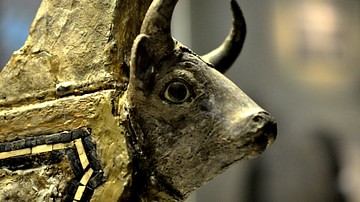
Cow's Head Detail, Silver Lyre, Ur
The silver cow's head decorating the front has inlaid eyes of shell and lapis lazuli. This lyre was found in the 'Great Death-Pit', one of the graves in the Royal Cemetery at Ur. From Ur, southern Mesopotamia, Iraq...
Image
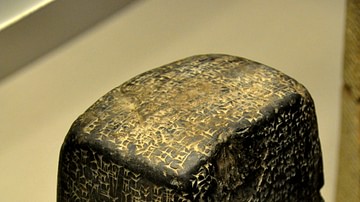
Stone Foundation Document of King Adad-Nirari I
Rectangular stone foundation document of the Assyrian king Adad-Nirari I. It recounts the king's victories over the Mitanni, who had failed to gain Hittite support, and the extension of Assyrian rule...

Image
Headdress and Necklaces from the Royal Cemetery of Ur
An elaborate headdress and necklace made of gold, lapis lazuli, and carnelian which belonged to a high-level Sumerian woman. These were found in the "Great Death-Pit", one of the graves in the Royal...

Image
Map of Ancient Georgian States (600-150 BCE)
Map showing the ancient states in the western Caucasus (modern-day Georgia) from c. 600 BCE to 150 BCE.
Image
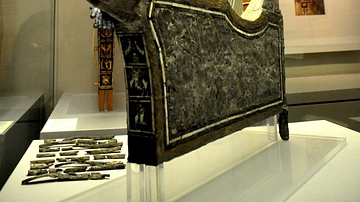
Silver Lyre, Ur, Mesopotamia
This lyre was found in the 'Great Death-Pit', one of the graves in the Royal Cemetery at Ur. From Ur, southern Mesopotamia, Iraq. Early dynastic period, 2600-2400 BCE. (The British Museum, London)

Image
King Tiglath-pileser III
An alabaster bas-relief depicting the Assyrian king Tiglath-pileser III. From the central palace, Nimrud (ancient Kalhu), Mesopotamia, northern Iraq. Neo-Assyrian era, circa 728 BCE. (The British Museum, London)
Image
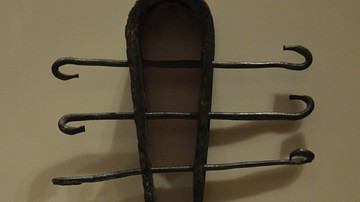
Ancient Egyptian Sistrum
Bronze Sistrum (rhythm instrument) with handle in the shape of the god Bes, 30th Dynasty, c. 350 BCE. (Neues Museum, Berlin)
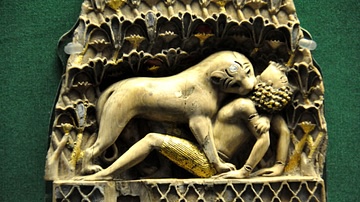
Image
Lioness Devouring a Boy, Phoenician Ivory Panel
This Phoenician carved ivory panel is one of an almost identical pair with one now in the Iraq Museum, Baghdad. They originally formed part of a piece of furniture, perhaps a throne. The incised letter...
