
Search Definitions
Browse Content (p. 285)

Definition
Knap of Howar
The Knap of Howar is a Neolithic site on the island of Papa Westray in Orkney, Scotland. The name is Old Norse for `mound of mounds' or `large barrow'. The building preserved at the site is considered the oldest stone house in...
Definition
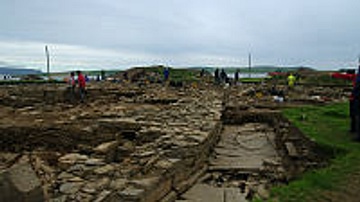
Ness of Brodgar
The Ness of Brodgar is a Neolithic Age site discovered in 2002 CE through a geophysical survey of the area of land in Stenness in Orkney, Scotland, which separates the salt water Stenness Loch from the fresh water Harray Loch...

Definition
Ancient Scotland
Scotland is a country which, today, comprises the northern part of Great Britain and includes the islands known as the Hebrides and the Orkneys. The name derives from the Roman word "Scotti" which designated an Irish tribe who...

Definition
Neodamodeis
A huge part of the Spartan population was made up of those who were not actually Spartan, the helots; a cause of great concern to the Spartans throughout their history. These helots were slaves that were usually captives of the Spartans...

Definition
Centaur
A centaur was a creature from Greek mythology which was half-man and half-horse. The head, arms and torso of a centaur were human and joined at the waist to the body and legs of a horse. Centaurs represented barbarism and unbridled chaos...

Definition
Nike - Greek Goddess of Victory
The ancient Greek goddess Nike was the personification of the ideal of victory. Such personifications of ideal terms were common in ancient Greek culture; other examples include Wisdom, Knowledge, and Justice. Unlike...

Definition
Achilles
Achilles is a figure from Greek mythology and literature and star of the Trojan War. Leader of the fearsome Myrmidons, sacker of cities, and slayer of Hector, godlike Achilles was quite simply invincible in battle. Only the divine intervention...

Definition
Justinian I
Justinian I reigned as emperor of the Byzantine Empire from 527 to 565 CE. Born around 482 CE in Tauresium, a village in Illyria, his uncle Emperor Justin I was an imperial bodyguard who reached the throne on the death of Anastasius...

Definition
Dionysos
Dionysos (Roman name: Bacchus, also known as Dionysus) was the ancient Greek god of wine, merriment, and theatre. Being the bad boy of Mt. Olympus, Dionysus was perhaps the most colourful of the Olympian Gods. Son of Zeus In Greek...

Definition
Sistrum
The sistrum (rattle) was a musical percussion instrument first used by the ancient Egyptians, commonly used in ancient Greek musical practices, and often depicted in visual arts such as sculpture and pottery. Made from clay, wood, or...
