

| Rating: | |
|---|---|
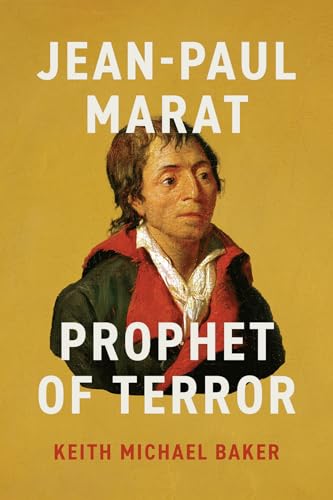
| Title: | Jean-Paul Marat: Prophet of Terror (The Life of Ideas) |
| Author: | Keith Michael Baker |
| Audience: | University |
| Difficulty: | Medium |
| Publisher: | University of Chicago Press |
| Published: | 2025 |
| Pages: | 952 |
Keith Michael Baker's comprehensive biography of Jean-Paul Marat is highly recommended. The book covers three phases of Marat's life that illustrate his journey into the political populism and violent rhetoric that came to characterize the French Revolution. Baker's book is extremely well-researched, balanced, and accessible to scholars and the general public alike.
Keith Michael Baker’s Jean-Paul Marat: Prophet of Terror is a 27-chapter comprehensive biography of one of the men identified with the French Revolution’s most violent period. While mostly known today as the author of the radical pamphlet, The People’s Friend (L’Ami du Peuple), and of the subject of the famous portrait by Jacques-Louis David of the man murdered in his tub, Jean-Paul Marat is shown by Baker through a life story of how Marat was radicalized over time. Baker, an experienced historian on Early Modern Europe and J.E. Wallace Sterling Professor in Humanities at Stanford University, aims to “make sense of those ‘sublime words of the prophet-Marat,’ the radical journalist and martyred deputy who notorious calls for blood gave voice to some of the most frightful impulses of the French Revolution" (1).
The book covers three phases of Marat’s life, beginning in the 1760s as a medical practitioner in Neuchâtel and London. During this phase, Marat seemed to be equally interested in serious scientific experimentation and in finding recognition for his achievements. After taking on the likes of Isaac Newton and Benjamin Franklin’s works, he was met with disdain by the scientific establishment. While in London, Marat witnessed a radical journalist being elected to the British Parliament and then denying his seat. This influenced him to write his first political work, The Chains of Slavery (1774). Baker shows that Marat’s failure to be recognized as a serious scientist should be understood alongside his growing distrust of political authority.
As a reader, the second part of the book, set in pre-revolutionary Paris, was the most illuminating. Baker tells the story of Marat moving to the city, hoping again to achieve recognition and profit as a doctor in 1777. While he achieved financial success, he was rejected by the scholars of the Paris Academy of Sciences. The lack of public recognition for what he believed was innovative scientific work intensified his already distrustful opinion of authority and his work toward calling for more radical remedies. One can draw a clear line from Marat’s grievances and his calls for the destruction of institutions that he viewed as despotic.
The third part of the book takes the reader to more familiar ground of Marat's role in the French Revolution. In 1789, he was physically unwell, out of money, and looking for a way to gain opportunities outside of science and in politics. He understood the power of the popular press from his time in England and started writing daily as The Friend of the People. He later became an elected representative to the National Convention in 1792. It is during this time that Marat’s voice becomes stridently violent. He frequently argued for the necessity of bloodshed as he wrote: “cowardly citizens, you’ll be subjected to all the horrors of tyranny if you don’t crush its henchmen and choke them in their own blood" (352). As Baker notes, Marat “was a man who dreamed of violence all the way down" (352). While this section will be the most familiar to those interested in the French Revolution, Baker examines Marat’s difficult relationships with figures such as Robespierre, Danton, and Brissot. He effectively shows how the momentum of denunciations and distrust accelerated through the popular press and fueled hostilities among men who had initially mostly agreed on Revolutionary ideals. The book ends with Marat’s murder in 1793 and the immediate aftermath of it.
This book is aimed toward scholars of the French Revolution, given its comprehensive approach at 952 pages. However, for enthusiasts of the subject, there is much to be gained in this book, particularly the first two sections that examine parts of Marat’s life that have received less attention. The book succeeds in showing Marat’s political evolution into violent radicalism and the power he wielded in Revolutionary France through the popular press.
About the Reviewer
Related Content
Assassination of Marat

Power Struggles in the Reign of Terror

French Involvement in the American Revolution
Cite This Work
APA Style
Palmer, K. (2026, March 16). Jean-Paul Marat: Prophet of Terror. World History Encyclopedia. https://www.worldhistory.org/review/555/jean-paul-marat-prophet-of-terror/
Chicago Style
Palmer, Kelly. "Jean-Paul Marat: Prophet of Terror." World History Encyclopedia, March 16, 2026. https://www.worldhistory.org/review/555/jean-paul-marat-prophet-of-terror/.
MLA Style
Palmer, Kelly. "Jean-Paul Marat: Prophet of Terror." World History Encyclopedia, 16 Mar 2026, https://www.worldhistory.org/review/555/jean-paul-marat-prophet-of-terror/.
