

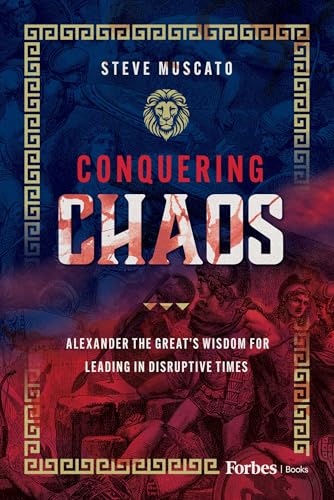
| Rating: | |
|---|---|
| Title: | Conquering Chaos: Alexander the Great's Wisdom for Leading in Disruptive Times |
| Author: | Steve Muscato |
| Audience: | General Public |
| Difficulty: | Easy |
| Publisher: | Forbes Books |
| Published: | 2026 |
| Pages: | 184 |
Steve Muscato’s "Conquering Chaos" reimagines Alexander the Great’s conquests as a masterclass in modern crisis management. By blending historical narrative with leadership strategy, Muscato illustrates how Alexander’s tactical speed and "lead from the front" ethos remain relevant in today’s volatile landscape. While it leans toward applied history rather than academic biography, the book provides a sharp and pragmatic look at how audacity builds empires and how hubris eventually destroys them.
In Conquering Chaos: Alexander the Great’s Wisdom for Leading in Disruptive Times, Steve Muscato attempts to synthesise the lightning-fast military conquests of the 4th century BCE with the high-stakes demands of modern corporate leadership. One must evaluate this work not just as a business manual, but as a bridge between historical record and modern application. Muscato, who brings his own background in crisis management during events like 9/11 and various economic upheavals, uses Alexander as the ultimate case study in agility. He demonstrates how the Macedonian king’s ability to move his forces faster than news of his arrival allowed him to dismantle the world's largest empire in a single decade.
The book is organised into three distinct thematic sections that mirror the trajectory of Alexander’s life. The first, "The Architect of Speed," focuses on the reforms of Philip II and Alexander’s early consolidation of power. Here, Muscato explores the development of the Macedonian Sarissa and the logistical overhaul of the baggage train. The second section, "The Empire Breaker," provides a chronological analysis of the major set-piece battles—Granicus, Issus, and Gaugamela—framing them as case studies in market disruption. Finally, "The Weight of the Crown" deals with the complexities of governance, the integration of Persian customs, and the eventual psychological decline of the King.
Muscato’s approach is firmly rooted in military and social history, but he views historical questions through a pragmatic "lessons-learned" lens. While he does not offer new archaeological data, he engages thoughtfully with primary sources, drawing heavily from Arrian’s Anabasis of Alexander and Plutarch’s Lives. He balances these ancient accounts with modern secondary scholarship from Peter Green and Robin Lane Fox, ensuring that while the application is modern, the historical foundation is not purely anecdotal.
This book's narrative succeeds most effectively when it analyzes Alexander’s logistical and tactical innovations. Muscato highlights how Alexander’s refusal to follow conventional Persian rules of engagement allowed him to turn overwhelming odds into decisive victories. For history enthusiasts, the book’s deep dive into the "Macedonian machine" provides a vivid look at the discipline of the phalanx and the psychological weight of a leader who physically leads from the front. The author argues that Alexander’s success was not merely a result of individual genius but a byproduct of a culture that prioritized speed, adaptability, and a refusal to accept the status quo—traits that are increasingly essential in today’s volatile global economy.
From an editorial standpoint, the book is well-equipped for the visual learner. It includes several high-quality grayscale maps detailing the route of the Macedonian army and the specific troop movements at Gaugamela, which are essential for following the tactical breakdowns. Additionally, Muscato includes "Command Summary" tables at the end of each chapter, which distill complex historical maneuvers into bulleted strategic principles. These data points help bridge the gap between 330 BCE and the contemporary boardroom.
However, the book leans heavily into "applied history," which occasionally simplifies the darker, more complex realities of Alexander’s reign. While Muscato does address the "hubris warning" and the eventual unraveling of Alexander’s empire, the focus remains primarily on positive strategic takeaways. The book treats the policy of proskynesis and Alexander’s cultural integration less as a point of scholarly debate and more as a lesson in managing diverse organizational cultures.
Ultimately, Conquering Chaos serves as a compelling strategic post-mortem of one of history’s most influential figures. Regarding its intended audience, this work is most suitable for "history-adjacent" professionals or history enthusiasts who enjoy seeing ancient theory tested against modern practice. It may lack the granular historiographic debate required for a strictly academic or postgraduate audience, as it prioritizes utility over nuance.
It manages to make ancient history feel visceral and urgent, proving that while technology and geography have changed, the fundamental human elements of leadership—courage, unity, and the avoidance of self-sabotage—remain constant. For those who appreciate seeing history through a pragmatic lens, Muscato offers a unique perspective on how the victories and missteps of the past can sharpen the decision-making of the present.
About the Reviewer
Related Content

Alexander the Great: A Case Study in Martial Leadership

Alexander the Great as a God

The Army of Alexander the Great
Cite This Work
APA Style
Panagi, K. (2026, April 24). Conquering Chaos: Alexander the Great’s Wisdom for Leading in Disruptive Times. World History Encyclopedia. https://www.worldhistory.org/review/549/conquering-chaos-alexander-the-greats-wisdom-for-l/
Chicago Style
Panagi, Katerina. "Conquering Chaos: Alexander the Great’s Wisdom for Leading in Disruptive Times." World History Encyclopedia, April 24, 2026. https://www.worldhistory.org/review/549/conquering-chaos-alexander-the-greats-wisdom-for-l/.
MLA Style
Panagi, Katerina. "Conquering Chaos: Alexander the Great’s Wisdom for Leading in Disruptive Times." World History Encyclopedia, 24 Apr 2026, https://www.worldhistory.org/review/549/conquering-chaos-alexander-the-greats-wisdom-for-l/.
