


The five classical orders of architecture: Doric, Ionic, Corinthian, Tuscan, and Composite, are systems of proportion, structure, and ornament that organize the relationship between a column and its entablature. Doric, Ionic, and Corinthian developed in the ancient Greek world, while Tuscan and Composite were associated more strongly with Roman and Italic traditions. Together, they became the foundation of a highly influential architectural language later systematized by Renaissance theorists.
- Doric Order – developed in Greece from the 7th century BCE and is characterized by sturdy proportions, plain capitals, and a frieze of alternating triglyphs and metopes. It became especially associated with monumental temple architecture.
- Ionic Order – emerged in the Greek cities of Ionia and the Aegean and is distinguished by more slender proportions, bases beneath the columns, and capitals with prominent spiral volutes.
- Corinthian Order – developed in the Greek world by the late 5th and 4th centuries BCE and is recognizable by its elaborate capital decorated with acanthus leaves. Roman architects later used it extensively in monumental buildings.
- Tuscan Order – associated with Italic and Etruscan architectural traditions and later formalized by Roman writers. It is a simplified order with smooth, usually unfluted columns, plain capitals, and relatively restrained ornament.
- Composite Order – developed in Roman imperial architecture and combines the large volutes of the Ionic order with the acanthus foliage of the Corinthian, creating one of the most elaborate classical forms.
Greek and Roman architects used these orders not simply as decorative column types but as coherent systems governing proportion, structure, and visual hierarchy. Vitruvius described Greek and Italic architectural principles in De architectura in the 1st century BCE, while Renaissance architects later codified the familiar system of five canonical orders. Revived repeatedly from the Renaissance through Neoclassicism, the classical orders became one of the most enduring visual languages in the history of architecture
About the Author
Related Images

The Doric Order, Classical Orders of Architecture
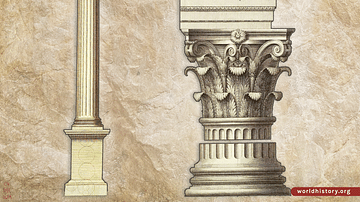
The Corinthian Order, Classical Orders of Architecture
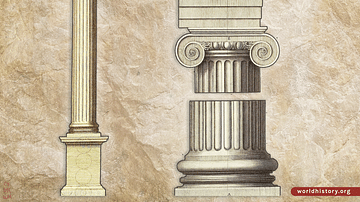
The Ionic Order, Classical Orders of Architecture

Five Classical Orders of Serlio

Six Tuscan Poets by Vasari
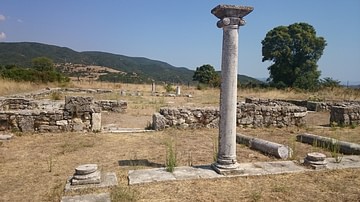
Ionic Column, Amphipolis
Cite This Work
APA Style
Netchev, S. (2026, September 22). The 5 Classical Orders of Architecture: Doric, Ionic, Corinthian, Tuscan & Composite. World History Encyclopedia. https://www.worldhistory.org/image/948/the-5-classical-orders-of-architecture/
Chicago Style
Netchev, Simeon. "The 5 Classical Orders of Architecture: Doric, Ionic, Corinthian, Tuscan & Composite." World History Encyclopedia, September 22, 2026. https://www.worldhistory.org/image/948/the-5-classical-orders-of-architecture/.
MLA Style
Netchev, Simeon. "The 5 Classical Orders of Architecture: Doric, Ionic, Corinthian, Tuscan & Composite." World History Encyclopedia, 22 Sep 2026, https://www.worldhistory.org/image/948/the-5-classical-orders-of-architecture/.
