


The Second World War (1939–1945) pushed industrialized warfare to an unprecedented scale. Military effectiveness depended not only on weapons themselves but on the ability of states to design, mass-produce, supply, maintain, and continually improve them. Tanks, aircraft, and utility vehicles became central to mechanized warfare, air power, and global logistics. These six machines illustrate contrasting approaches to firepower, mobility, protection, range, reliability, and industrial production.
- Panzerkampfwagen IV (Germany) – Germany's principal medium tank evolved from an infantry-support vehicle into a more heavily armed fighting machine. About 8,500 were built between 1937 and 1945, and repeated upgrades allowed it to remain important throughout the war.
- T-34 (Soviet Union) – combining mobility, sloped armour, effective firepower, and relatively simple mass production, the T-34 became the Red Army's principal medium tank. Around 57,000 were produced by the end of 1945, making it central to Soviet operations on the Eastern Front.
- M4 Sherman (United States) – designed around reliability, standardization, and ease of maintenance, the Sherman became the principal American medium tank and was supplied widely to Allied armies. Roughly 49,000 were produced between 1942 and 1945.
- Supermarine Spitfire (United Kingdom) – one of the most recognizable Allied fighters, the Spitfire played a major role in the Battle of Britain and remained in service through continual technological development. More than 20,000 were produced in numerous variants.
- Mitsubishi A6M Zero (Japan) – designed for exceptional range and manoeuvrability, the Zero became the leading Japanese carrier fighter during the early Pacific War. Its advantages came partly at the expense of armour and survivability, and later Allied aircraft increasingly surpassed it.
- Willys MB "Jeep" (United States) – a simple, rugged four-wheel-drive vehicle used for reconnaissance, transport, communications, and support. Around 650,000 wartime jeeps were produced, making the type a powerful example of the logistical mobility underpinning Allied operations.
No single machine determined the outcome of the war. Industrial capacity, access to fuel and raw materials, trained crews, maintenance, logistics, and the ability to replace losses often mattered as much as individual technical specifications. These six designs therefore illustrate a defining feature of total war: battlefield technology was inseparable from economic mobilization and mass production. Their influence also extended beyond 1945, shaping postwar armoured warfare, aviation, military logistics, and civilian vehicle design.
About the Author
Related Images

Mitsubishi A6M Zero Fighters

Mitsubishi A6M Zero in Flight
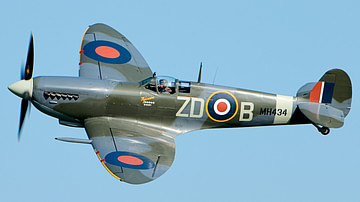
Supermarine Spitfire, 2018

Kamikaze Zero & USS Missouri

US Marines and Wrecked Zero, Iwo Jima

RAF Spitfire
Cite This Work
APA Style
Netchev, S. (2026, October 25). 6 Machines That Shaped World War II: Tanks, Fighters, and the Industrial Power of Total War. World History Encyclopedia. https://www.worldhistory.org/image/21504/6-machines-that-shaped-world-war-ii/
Chicago Style
Netchev, Simeon. "6 Machines That Shaped World War II: Tanks, Fighters, and the Industrial Power of Total War." World History Encyclopedia, October 25, 2026. https://www.worldhistory.org/image/21504/6-machines-that-shaped-world-war-ii/.
MLA Style
Netchev, Simeon. "6 Machines That Shaped World War II: Tanks, Fighters, and the Industrial Power of Total War." World History Encyclopedia, 25 Oct 2026, https://www.worldhistory.org/image/21504/6-machines-that-shaped-world-war-ii/.
