
Celebrate Our Anniversary with Trivia!
Join us on August 23 for a free virtual trivia party featuring questions about ancient civilizations, U.S. history, unusual historical facts, pop culture, and more.


The Kingdom of the Vandals and Alans (435–534 CE) emerged as one of the most significant post-Roman states in the western Mediterranean. Founded after the Vandals, a Germanic people originally from Central Europe, and the Alans, an Iranian-speaking Sarmatian group, migrated across Gaul and Iberia, it was established in North Africa under King Gaiseric (reign 428–477 CE). From their capital at Carthage (seized in 439 CE), the Vandals built a strong maritime kingdom that controlled key trade routes and islands such as Sardinia, Corsica, and the Balearics. Their naval strength allowed them to dominate the western Mediterranean, and their Sack of Rome in 455 CE became legendary, later giving rise to the modern term “vandalism.”
Despite its power, the kingdom faced ongoing religious and political tensions. The Vandals were Arian Christians, often clashing with the Nicene (Catholic) majority of their North African subjects. Over time, internal instability and weakened defenses left the state vulnerable. The end came with the Byzantine Vandalic War (533–534 CE), when Emperor Justinian I (reign 527–565 CE) dispatched General Belisarius, who swiftly reconquered the region for Constantinople. Though short-lived, the Vandal kingdom represented a crucial bridge between the fall of the Western Roman Empire and the Byzantine resurgence in the Mediterranean.
About the Author
Related Images
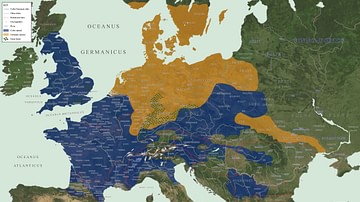
Map of Celtic and Germanic Tribes

Map of the Migration Period in Europe in the 4th-5th Century

Map of Odysseus’ 10-year Journey Home

Map of the Fall of the Western Roman Empire, c. 480 CE

Map of Roman North Africa - Provinces, Roads & Frontiers - Expansion, administration & economic foundations 146 BCE–395

Map of WWII North Africa Campaign, 1940-1943
Cite This Work
APA Style
Netchev, S. (2025, January 20). Map of the Kingdom of the Vandals (435–534 CE). World History Encyclopedia. https://www.worldhistory.org/image/19898/map-of-the-kingdom-of-the-vandals-435-534-ce/
Chicago Style
Netchev, Simeon. "Map of the Kingdom of the Vandals (435–534 CE)." World History Encyclopedia, January 20, 2025. https://www.worldhistory.org/image/19898/map-of-the-kingdom-of-the-vandals-435-534-ce/.
MLA Style
Netchev, Simeon. "Map of the Kingdom of the Vandals (435–534 CE)." World History Encyclopedia, 20 Jan 2025, https://www.worldhistory.org/image/19898/map-of-the-kingdom-of-the-vandals-435-534-ce/.
