


The Ottoman Empire under Suleiman I (reign 1520–1566), known as Suleiman the Magnificent in Europe and Kanuni (the Lawgiver) in Ottoman tradition, became one of the dominant powers of the sixteenth century. Building on earlier conquests, Suleiman expanded Ottoman control in Hungary after the Battle of Mohács (1526), secured Baghdad in 1534, and strengthened naval influence across the Mediterranean and Red Sea. His empire encompassed directly administered provinces, tributary states, and contested frontier territories across Europe, Asia, and Africa.
Suleiman's reign also reshaped early modern diplomacy. Rivalry with the Habsburgs and Safavid Persia coexisted with an alliance with France and commercial relations with Venice. The Peace of Amasya (1555) stabilized the eastern frontier, while legal reforms, administrative consolidation, and artistic patronage strengthened imperial institutions. Often regarded as a high point of Ottoman political and cultural achievement, his reign helped establish the foundations of an enduring imperial system.
About the Author
Related Images

Suleiman the Magnificent
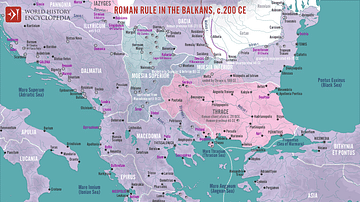
Roman Rule in the Balkans, c. 200 CE

Second Siege of Vienna 1683 CE

John Sigismund of Hungary with Suleiman I

Mehmed II Conquers Constantinople

Map of Europe in 1815 and the Vienna Settlement - The Congress of Vienna and the Post-Napoleonic Order
Cite This Work
APA Style
Netchev, S. (2026, October 11). Map of the Ottoman Empire under Suleiman the Magnificent: Ottoman Conquest, Diplomacy, and Law, 1520–1566. World History Encyclopedia. https://www.worldhistory.org/image/17127/map-of-the-ottoman-empire-under-suleiman-the-magni/
Chicago Style
Netchev, Simeon. "Map of the Ottoman Empire under Suleiman the Magnificent: Ottoman Conquest, Diplomacy, and Law, 1520–1566." World History Encyclopedia, October 11, 2026. https://www.worldhistory.org/image/17127/map-of-the-ottoman-empire-under-suleiman-the-magni/.
MLA Style
Netchev, Simeon. "Map of the Ottoman Empire under Suleiman the Magnificent: Ottoman Conquest, Diplomacy, and Law, 1520–1566." World History Encyclopedia, 11 Oct 2026, https://www.worldhistory.org/image/17127/map-of-the-ottoman-empire-under-suleiman-the-magni/.
