


Apulian red-figure drinking-vessel from c. 360 BCE, attributed to the Illupersis Painter of South Italy (active c. 375-350 BCE), The J. Paul Getty Collection, Malibu, no. 71.AE.196
Horn-shape drinking vessels are among the earliest finer artefacts developed in various civilisations. From the 2nd millennia BCE onwards, they appear in and around the Near East and Central Asia with zoomorphic heads shaped as boars, lions and lionesses, goats, panthers, and bulls. Following the defeat of the Persians by the Greeks in 479 BCE, Persian horn-pitchers of gold, silver, and ivory were introduced to the Greeks and adopted by them under the name of rhyton (roughly meaning ‘pourer’ or ‘pouring vessel’). Ceramic rhyta from mainland Greece and its colonies in South Italy were often decorated around the neck with mythical scenes and characters related to wine-drinking, wine-god Dionysos, dancing, and revelry. This bull-head rhyton is an example, displaying a female dancer, perhaps a maenad, dancing with a tympanon.
About the Author
Related Images

Bull’s Head Rhyton from Knossos

Woman Playing the Tympanon
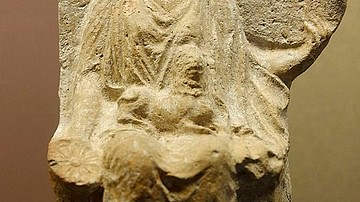
Cybele with Patera, Lion & Tympanon
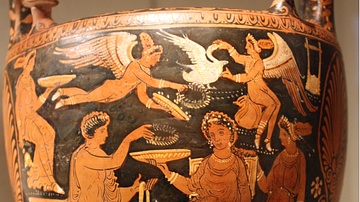
Apulian Lebes Gamikos

Apulian Volute Krater with Scenes of the Underworld (detail)
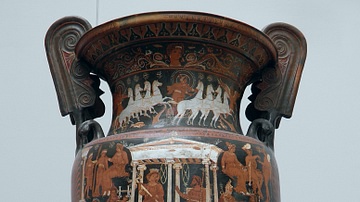
Apulian Krater with Scenes of the Underworld
Cite This Work
APA Style
Choubineh, N. (2021, March 05). Bull Head Rhyton with Dancer & Tympanon. World History Encyclopedia. https://www.worldhistory.org/image/13519/bull-head-rhyton-with-dancer--tympanon/
Chicago Style
Choubineh, Nathalie. "Bull Head Rhyton with Dancer & Tympanon." World History Encyclopedia, March 05, 2021. https://www.worldhistory.org/image/13519/bull-head-rhyton-with-dancer--tympanon/.
MLA Style
Choubineh, Nathalie. "Bull Head Rhyton with Dancer & Tympanon." World History Encyclopedia, 05 Mar 2021, https://www.worldhistory.org/image/13519/bull-head-rhyton-with-dancer--tympanon/.
