
Search
Remove Ads
Advertisement
Search Results

Definition
Enlil - Mesopotamian Keeper of the Tablets of Destiny
Enlil (also known as Ellil and Nunamnir) was the Sumerian god of the air in the Mesopotamian pantheon, but he was more powerful than any other elemental deity and eventually was worshiped as King of...

Definition
Temple
A temple (from the Latin templum) is a structure usually built for the purpose of, and always dedicated to, religious or spiritual activities including prayer, meditation, sacrifice and worship. The templum was a sacred precinct defined...

Definition
Early Dynastic Period in Mesopotamia - Era of Many of the "Firsts" in Civilization
The Early Dynastic period in Mesopotamia is the modern-day archaeological term for the era in Mesopotamian history – circa 2900 to circa 2350/2334 BCE – during which some of...

Definition
Ninurta - The Sumerian Hero-God of War
Ninurta (identified with Ningirsu, Pabilsag, and the biblical Nimrod) is the Sumerian and Akkadian hero-god of war, hunting, and the south wind. He first appears in texts in the early 3rd millennium BCE as an...

Definition
Dur-Sharrukin
Dur-Sharrukin (modern Khorsabad, Iraq) was a city built by Sargon II of Assyria (r. 722-705 BCE) as his new capital between 717-706 BCE. The name means Fortress of Sargon and the building project became the king's near obsession...

Article
Enlil in the E-kur - Praising God in Ancient Mesopotamia
Enlil in the E-Kur (circa 2000 BCE) is a Sumerian hymn praising the sky god Enlil, his temple/ziggurat at Nippur, and his consort Ninlil, depicting all three in glowing terms and Enlil as a creator...

Collection
Mesopotamian Gods - A Brief Survey of Some Great Mesopotamian Deities
The gods of Mesopotamia are first evidenced during the Ubaid Period (circa 6500-4000 BCE) when temples were raised to them, but their worship developed during the Uruk Period (circa 4000-3100...

Image
Recreation of the Etemenanki in Babylon
The Etemenanki (Sumerian for: "temple of the foundation of heaven and earth") was a massive ziggurat dedicated to Marduk in ancient Babylon. It is unclear when the Etemenanki was originally constructed, and...

Image
Ruins of Ur
The ruins of the temple complex of the city of Ur in modern-day Southern Iraq, with the Great Ziggurat of Ur in the background. The temple complex was where the poet priestess Enheduanna (circa 2300 BCE) would have worked and written...
Image
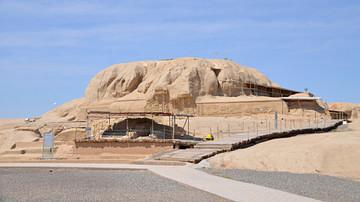
Tepe Sialk, Iran
Tepe Sialk is an archeological site (a tepe, "hill, tell") near Kashan in central Iran consisting of two hills with six main phases of occupation. The oldest settlements in Sialk date to around 6000–5500 BCE while the ziggurat...
