
Search
Remove Ads
Advertisement
Search Results

Image
Chogha Zanbil (Dur Untash)
Elamite Ziggurat located in today's Khuzestan Province in Iran. It was constructed in approximately 1250 BCE in a religious city originally called Dur Untash.

Image
A Stamped Mud Brick, Borsippa
Stamped mud brick from the temple and ziggurat of God Nabu. Borsippa, Mesopotamia, Iraq.

Image Gallery
A Gallery of Mesopotamian Religion
Mesopotamian religion was informed by the belief that humans were co-workers with the gods in maintaining the order created at the beginning of time and so religious expression was integral to daily life in ancient...

Definition
Uruk - The First Great City
Uruk was one of the most important cities (at one time, the most important) in ancient Mesopotamia. According to the Sumerian King List, it was founded by King Enmerkar circa 5000/4500 BCE. Uruk is best known as the birthplace...

Definition
Religion in the Ancient World - Order and the Spiritual Experience
Religion (from the Latin Religio, meaning "restraint," or Relegere, according to Cicero, meaning "to repeat, to read again," or, most likely, Religionem, "to show respect for what is sacred"...
Definition
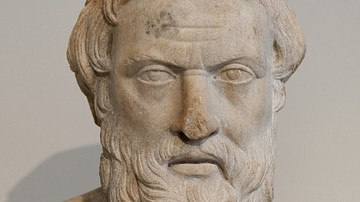
Herodotus
Herodotus (l. c. 484 – 425/413 BCE) was a Greek historian famous for his work Histories. He was called The Father of History by the Roman writer Cicero, who admired him, but has also been rejected as The Father of Lies by critics...

Definition
Cyrus the Great
Cyrus II (d. 530 BCE), also known as Cyrus the Great, was the fourth king of Anshan and the first king of the Achaemenid Empire. Cyrus led several military campaigns against the most powerful kingdoms of the time, including Media...

Definition
Nanna - Mesopotamian God of the Moon and Wisdom
Nanna (also known as Nannar, Nanna-Suen, Sin, Asimbabbar, Namrasit, Inbu) is the Mesopotamian god of the moon and wisdom. He is one of the oldest gods in the Mesopotamian pantheon and is first mentioned...

Definition
Enki - The Tricky Sumerian God of Wisdom
Enki (also known as Ea, Enkig, Dis, Nagbu, Nissiku Nudimmud) was the Sumerian god of wisdom, freshwater, intelligence, trickery and mischief, crafts, magic, exorcism, healing, creation, virility, fertility...

Definition
Nebuchadnezzar II
Nebuchadnezzar II (r. 605/604-562 BCE) was the greatest King of ancient Babylon during the period of the Neo-Babylonian Empire (626-539 BCE), succeeding its founder, his father, Nabopolassar (r. 626-605 BCE). He is best known...
