
Search
Remove Ads
Advertisement
Search Results

Definition
Chanakya
Chanakya (l. c. 350-275 BCE, also known as Kautilya and Vishnugupta) was prime minister under the reign of Chandragupta Maurya (r. c. 321-c.297 BCE), founder of the Mauryan Empire (322-185 BCE). He is best known as the author of the...

Definition
Taejo of Goryeo
Taejo (r. 918-943 CE), previously known as Wang Geon or Wang Kon, was the founder and first king of the Goryeo (Koryo) kingdom which unified and ruled ancient Korea from 918 CE to 1392 CE. Wang Geon was given the posthumous title...
Definition
Hachiman - Origin of the Kamikaze Wind
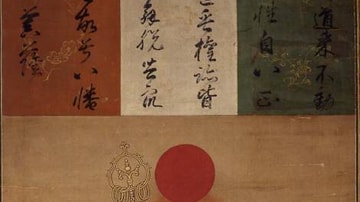
Hachiman is the ancient Shinto god or kami of war, divination, and culture. He is famously credited with sending the kamikaze or 'divine wind' which twice dispersed the invading fleets of Mongol ruler Kublai Khan...

Definition
Shishunaga Dynasty
The Shishunaga Dynasty (also Sishunaga/Shaishunaga Dynasty) ruled the Magadha Kingdom in ancient India from c. 413 BCE to c. 345 BCE (in some sources from 421 BCE). It is said to be the third imperial dynasty of Magadha after...
Definition
Emperor Wuzong of Tang
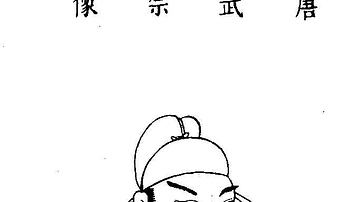
Wuzong of Tang (also Wu-Tsung, formerly Li Yan) reigned as emperor of China from 840 to 846 CE. He is best remembered today for his persecution of Buddhists, the worst such attack in all of China's history, and his early...

Definition
Gnosticism
Gnosticism is the belief that human beings contain a piece of God (the highest good or a divine spark) within themselves, which has fallen from the immaterial world into the bodies of humans. All physical matter is subject to decay...

Definition
Noh Theatre
Noh (Nō) theatre is a Japanese performance art which became especially popular from the 14th century CE and which is still performed today. Noh actors, who were always male in the medieval period, famously move and make gestures in...

Article
Buddhist Illuminated Scripts of Ancient Korea
The Goryeo (Koryo) kingdom ruled ancient Korea from 918 CE to 1392 CE, and it oversaw a flourishing of the arts, literature, and architecture. One of these developments was the production of finely crafted...

Definition
Philosophy
The word philosophy comes from the Greek philo (love) and sophia (wisdom) and so is literally defined as “the love of wisdom”. More broadly understood, it is the study of the most basic and profound matters of human existence. Philosophical...

Definition
Harsha
Emperor Harshavardhana, better known as Harsha, lived from 590 to 647 CE and was the last ruler of the Vardhana Empire, the last great empire in ancient India before the Islamic Invasion. He ruled from 606 CE to 647 CE. After Harshavardhana's...
