
Search
Search Results

Definition
Taoism
Taoism (also known as Daoism) is a Chinese philosophy attributed to Lao Tzu (c. 500 BCE) which developed from the folk religion of the people primarily in the rural areas of China and became the official religion of the country under the...

Definition
Shang Dynasty
The Shang Dynasty (c. 1600-1046 BCE) was the second dynasty of China, which succeeded the Xia Dynasty (c. 2070-1600 BCE) after the overthrow of the Xia tyrant Jie by the Shang leader, Tang. Since many historians question whether the Xia Dynasty...

Definition
Chinese Emperor
The emperors of ancient China had tremendous power and responsibility. Called the 'Son of Heaven', he (and once she) was given a divine right to rule over all people but was expected to promote their best interest and not his own. An absolute...

Image
Map of the Tang Dynasty of China, c. 669 CE
The Tang Dynasty (618–907 CE) represents one of the high points of imperial Chinese history, reaching its widest territorial extent during the reign of Emperor Gaozong (reign 649–683 CE). By the late 7th century, around 669 CE, the empire...

Definition
Mandate of Heaven
The Mandate of Heaven (Tianming), also known as Heaven's Mandate, was the divine source of authority and the right to rule of China's early kings and then emperors. The ancient god or divine force known as Heaven or Sky selected a particular...

Image
Tang Dynasty Provinces c. 742 CE
The provinces of the Tang Dynasty c. 742 CE. The Tang Dynasty (618-907 CE) is regularly cited as the greatest imperial dynasty in ancient Chinese history. It was a golden age of reform and cultural advancement, which lay the groundwork for...
Definition
Balhae
The Balhae (Parhae) kingdom in Manchuria (698-926 CE) was an important regional power which interacted both peacefully and otherwise with its neighbours the Unified Silla Kingdom of Korea and Tang China. The latter was a strong cultural influence...

Image
Emperor Gaozu of Tang
A portrait of Chinese emperor Gaozu, founder of the Tang Dynasty, r. 618-626 CE.

Definition
Queen Seondeok
Queen Seondeok (Sondok) ruled the ancient kingdom of Silla from 632 to 647 CE and was the first female sovereign in ancient Korea. Silla was on the verge of dominating the whole of the Korean peninsula and Seondeok helped progress her kingdom...
Definition
Three Kingdoms Period in Korea
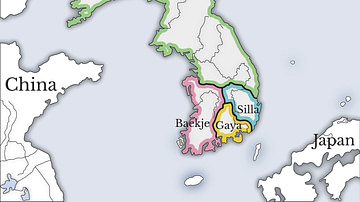
The Three Kingdoms Period of ancient Korea (57 BCE – 668 CE) is so-called because it was dominated by the three kingdoms of Baekje (Paekche), Goguryeo (Koguryo), and Silla. There was also, though, a fourth entity, the Gaya (Kaya) confederation...
