
Search
Remove Ads
Advertisement
Search Results

Article
Ancient Japanese & Chinese Relations
Relations between ancient Japan and China have a long history, and in certain periods the exchange of political, religious and cultural practices between the two was intense. China, the much older state and the...

Interview
Interview: Buddhism in Korea
In this interview, James Blake Wiener, Co-Founder and Communications Director at Ancient History Encyclopedia (AHE), speaks to Emeritus Professor James H. Grayson, Professor of Korean Studies at the University of Sheffield...
Article
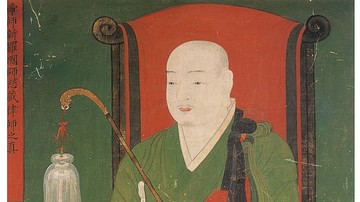
Famous Buddhist Monks of Ancient Korea
Throughout ancient Korea's history Buddhist monks were a particularly important element of state and religious affairs. From the 4th century CE onwards, in the Three Kingdoms period, they were members of a select...

Article
Religion in Ancient China
Religious practices in ancient China go back over 7,000 years. Long before the philosophical and spiritual teachings of Confucius and Lao-Tzu developed or before the teachings of the Buddha came to China, the people worshipped...

Article
Gender & Identity in Mulan: Text & Commentary
The legend of Mulan, now world-famous thanks to the Disney films of 1998 and 2020, is the story of a young girl who disguises herself as a man to take her aged father's place as a conscript in the army...

Definition
Nara Period
The Nara Period (Nara Jidai) of ancient Japan (710-794 CE), so called because for most of that time the capital was located at Nara, then known as Heijokyo, was a short period of transition prior to the significant Heian Period. Despite...

Definition
Khitan
The Khitan people formed the Liao dynasty and ruled parts of Mongolia, Manchuria, and northern China from 907 to 1125 CE. Adopting elements of Chinese government and culture, the Khitan were more than a match for their rivals the Song...

Definition
Lao-Tzu
Lao-Tzu (l. c. 500 BCE, also known as Laozi or Lao-Tze) was a Chinese philosopher credited with founding the philosophical system of Taoism. He is best known as the author of the Laozi (later retitled the Tao-Te-Ching translated as “The...

Definition
Taejo of Goryeo
Taejo (r. 918-943 CE), previously known as Wang Geon or Wang Kon, was the founder and first king of the Goryeo (Koryo) kingdom which unified and ruled ancient Korea from 918 CE to 1392 CE. Wang Geon was given the posthumous title...

Definition
Jang Bogo - Korea's King of the Yellow Sea
Jang Bogo (aka Chang Pogo or Gungbok) was a powerful Korean warlord, naval commander, and merchant who came to monopolise maritime trade in northeast Asia to such a degree that he was known as the 'King of...
