
Search
Remove Ads
Advertisement
Search Results

Definition
Phoenician Religion
The Phoenician Religion, as in many other ancient cultures, was an inseparable part of everyday life. Gods such as Baal, Astarte, and Melqart had temples built in their name, offerings and sacrifices were regularly made to...

Definition
Berbers
The Berbers have occupied North Africa, specifically the Maghreb, since the beginning of recorded history and until the Islamic conquests of the 8th century CE constituted the dominant ethnic group in the Saharan region. Modern Berber...

Definition
Tyche
In Greek mythology, Tyche is the goddess and personification of good luck, chance, and fortune. Tyche's popularity grew after the Classical period when many cities and officials across the Greek world and the Mediterranean adopted her...

Definition
Themis
Themis is the personification and goddess of divine law, will, and justice in Greek mythology. She was held in high esteem by the Olympians, often sitting by Zeus' throne and giving him wise counsel. Themis held the place of Oracle at...

Definition
Nyx
Nyx (also known as Nox or the Night) is the personification of the night in Greek mythology. Coming from Chaos (Void), Nyx is a primordial deity (Protogenoi). The Protogenoi represent the physical and elemental forces of the world and consist...

Definition
Ancient Persian Religion
Ancient Persian religion was a polytheistic faith which corresponds roughly to what is known today as ancient Persian mythology. It first developed in the region known as Greater Iran (the Caucasus, Central Asia, South...

Definition
Inanna - The Most Popular Goddess of Ancient Mesopotamia
Inanna is the ancient Sumerian goddess of love, sensuality, fertility, procreation, and also of war. She later became identified by the Akkadians and Assyrians as the goddess Ishtar, and further...
Definition
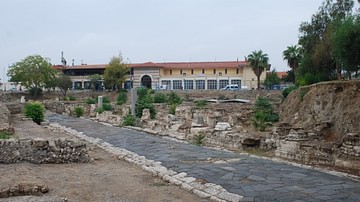
Tarsus
Tarsus was a city in ancient Cilicia located in the modern-day province of Mersin, Turkey. It is one of the oldest continually inhabited urban centers in the world, dating back to the Neolithic Period. It was built close by the Cydnus...

Definition
Stupa
A stupa (literally “heap” or “pile”) is a reliquary, a shrine containing the remains of a holy or sainted person and/or artifacts (relics) associated with them, originating in India prior to the 5th century BCE as tombs of holy men and...

Definition
Jainism
Jainism is one of the oldest religions in the world. The name comes from jiva (soul or life force but, capitalized, is also given as Spiritual Conqueror) as it maintains that all living things possess an immortal soul which has always...
