
Search
Did you mean: Wall?
Remove Ads
Advertisement
Search Results
Definition
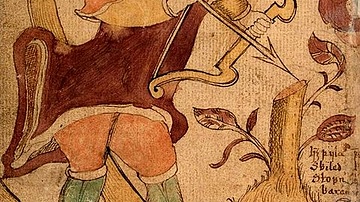
Ull
Ull (also known as Ullr), with his bow and skis, is such an elusive presence in Norse mythology that no conclusive remarks can be made about him. The 13th-century Icelandic author Snorri describes him only briefly in his Prose Edda, and he...

Article
Pirate Clothing in the Golden Age of Piracy
Pirates have gained a reputation for wearing bright and distinctive clothing and accessories during the Golden Age of Piracy (1690-1730) even if, in reality, most of what we think they wore comes from works of fiction like Robert Louis Stevenson’s...

Article
Trade in Medieval Europe
Trade and commerce in the medieval world developed to such an extent that even relatively small communities had access to weekly markets and, perhaps a day's travel away, larger but less frequent fairs, where the full range of consumer goods...

Article
Daily Life in Ancient Mesopotamia - Mirroring the Modern World
Daily life in ancient Mesopotamia cannot be described in the same way one would describe life in ancient Rome or Greece. Mesopotamia was never a single, unified civilization, not even under the Akkadian Empire of Sargon of Akkad (the Great...

Article
Fashion & Dress in Ancient Mesopotamia - From Basic to Accessorized in the Ancient World
Fashion and dress in Mesopotamia – clothing, footwear, and accessories – were not only functional but defined one's social status and developed from a simple loincloth in the Ubaid period (circa 6500-4000 BCE) to brightly colored robes and...

Article
Clothing in the Mongol Empire
The clothing worn by the Mongols in the 13th and 14th century CE, like most other aspects of their culture, reflected their nomadic lifestyle in the often harsh climate of the Asian steppe. Typical items included felt hats, long jackets with...

Article
Women in the Viking Age
Although women in the Viking Age (c. 790-1100 CE) lived in a male-dominated society, far from being powerless, they ran farms and households, were responsible for textile production, moved away from Scandinavia to help settle Viking territories...

Article
Trade in the Phoenician World
The Phoenicians, based on a narrow coastal strip of the Levant, put their excellent seafaring skills to good use and created a network of colonies and trade centres across the ancient Mediterranean. Their major trade routes were by sea to...

Article
Viking Hygiene, Clothing, & Jewelry
Although the Vikings are routinely depicted as rough, grimy, and violent, they were actually quite refined, took personal hygiene seriously, and wore fine clothes ornamented by jewelry. Some Christian chroniclers who condemned the Vikings...

Article
Cutty Sark - Fastest Ship in the World
With thousands of square feet of canvas capturing every breath of the trade winds, a 19th-century tea clipper was the absolute pinnacle of sailing evolution. The Cutty Sark was just such a ship, carrying tea and then wool across the far-flung...
