
Search
Remove Ads
Advertisement
Search Results

Definition
Krak Des Chevaliers
Krak des Chevaliers (also spelt Cracs des Chevaliers, and known in Arabic as Hisn al-Akrad) is a castle in Syria originally built for the Emir of Aleppo in 1031 CE but acquired and extensively rebuilt by the Knights Hospitaller...

Image
Hadrian's Wall at Cuddy’s Crags
A view of Hadrian's Wall at Cuddy's Crags, looking east along the wall, half a mile west of Housesteads Roman Fort.

Image
The Great Wall of China in Snow
A section of the Great Wall of China just north of Beijing. The wall was begun in the 7th century BCE and significantly extended by the Ch'in emperor Qin Shi Huangdi from 220 to 210 BCE.

Image
Hadrian's Wall Gate
The North Gate of Housesteads Fort on Hadrian's Wall. Passport control, immigration control and customs check all in one place. The wall was a checkpoint for taxing cross-border trade as well as a defence.
Image
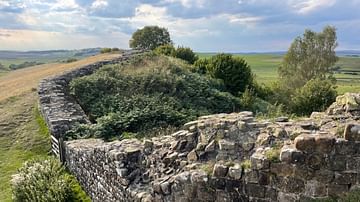
Hadrian's Wall at Thorny Doors
A stretch of Hadrian's Wall known as Thorny Doors, east of Milecastle 42 (Cawfields). At Thorny Doors stands one of the highest sections of surviving original wall.
Image
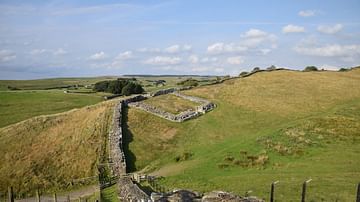
Hadrian's Wall, Milecastle 42 (Cawfields)
The Cawfields Milecastle (42) was one of the 81 milecastles along the length of Hadrian's Wall. These guardposts (or fortlets) were built at intervals of one Roman mile to control movement across the Wall...
Image
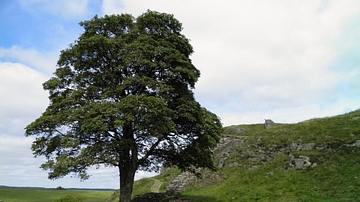
Hadrian's Wall, Sycamore Gap
Sycamore Gap on Hadrian's Wall is a section of the wall between two crests just east of Milecastle 39. It is locally known as the "Robin Hood Tree" for its use in the 1991 film Robin Hood: Prince of Thieves (1991).
Image
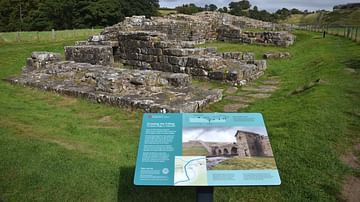
Hadrian's Wall, Willowford Roman Bridge
During Roman times, three bridges were built successively over the River Irthing to maintain continuity along Hadrian's Wall. The remains visible today in the Willowford sector of Hadrian's Wall represent various...

Image
Hadrian's Wall, Milecastle 39
The remains of Milecastle 39 on Hadrian's Wall near Steel Rigg. Each milecastle on Hadrian's Wall had two associated turret structures. These turrets were positioned approximately one-third and two-thirds of a Roman...

Article
The Isaurians and the End of Germanic Influence in Byzantium
Germanic influence reigned in the Roman Empire from the end of the 4th century CE through the 5th. Germanic individuals took important posts in the government and the military, and Germanic...
