
Search
Did you mean: Easter?
Remove Ads
Advertisement
Search Results

Article
The Mesopotamian Pantheon - The Ancient Gods and Goddesses of the Near East
The gods of the Mesopotamian region were not uniform in name, power, provenance or status in the hierarchy. Mesopotamian culture varied from region to region and, because of this...

Article
Mehrauli Archaeological Park
Mehrauli Archaeological Park is situated in Delhi, just beside the Qutb Complex (historically, Mehrauli was the first of the seven cities of Delhi). Spanning an area of more than 200 acres (80 ha), the site displays...

Article
Diodorus Siculus' Account of the Life of Semiramis
Semiramis is the semi-divine Warrior-Queen of Assyria, whose reign is most clearly documented by the Greek historian Diodorus Siculus (l. 90-30 BCE) in his great work Bibliotheca Historica ("Historical...

Definition
The Medieval Church
Religious practice in medieval Europe (c. 476-1500) was dominated and informed by the Catholic Church. The majority of the population was Christian, and "Christian" at this time meant "Catholic" as there was initially no other...

Definition
Chaco Canyon
Chaco Canyon was the center of a pre-Columbian civilization flourishing in the San Juan Basin of the American Southwest from the 9th to the 12th century CE. Chacoan civilization represents a singular period in the history of an ancient...

Definition
Avesta
The Avesta is the scripture of Zoroastrianism which developed from an oral tradition founded by the prophet Zoroaster (Zarathustra, Zartosht) sometime between c. 1500-1000 BCE. The title is generally accepted as meaning “praise”, though...
Definition
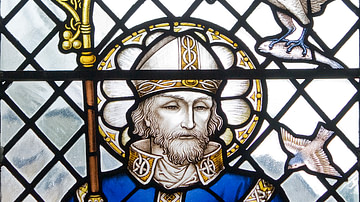
Saint Cuthbert
Saint Cuthbert (c. 634 - 20 March 687) was an Anglo-Saxon monk from the Kingdom of Northumbria, who became the bishop of Lindisfarne and one of the most important saints of the medieval church in England. He first became a monk...

Definition
Ten Plagues of Egypt
The story of the ten plagues of Egypt is found in chapters 7-12 of the Book of Exodus. The story depicts the natural disasters sent by the God of Israel to convince Pharaoh to let the Hebrew slaves leave Egypt. The narrative...

Definition
Pisistratus - Tyrant of Ancient Athens
Pisistratus (circa 600-527 BCE), or Peisistratus, was an ancient Greek tyrant who ruled the city-state of Athens. Initially a student of the lawgiver and political philosopher Solon, Pisistratus presented himself...

Definition
George Berkeley
George Berkeley (1685-1753) was an Anglo-Irish bishop and an empiricist and idealist philosopher. He infamously claimed that no matter exists outside of God and that things only exist outside of our minds and perceptions because...
