
Search
Did you mean: Wall?
Remove Ads
Advertisement
Search Results

Definition
Kalhu / Nimrud
Kalhu (also known as Caleh, Calah, and Nimrud, in modern-day northern Iraq) was a city in ancient Mesopotamia that became the capital of the Assyrian Empire under Ashurnasirpal II (r. 884-859 BCE) who moved the central government...

Definition
Ancient Egyptian Architecture
Ancient Egyptian architecture is often associated closely with the pyramids of Giza but was actually quite diverse, taking a number of forms in the construction of administrative buildings, temples, tombs, palaces...
Definition
Tiwanaku
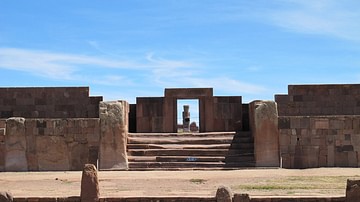
Tiwanaku (or Tiahuanaco) was the capital of the Tiwanaku empire between c. 200 - 1000 CE and is situated in the Titicaca basin. At an altitude of 3,850 metres (12,600 ft) it was the highest city in the ancient world and had a peak population...

Definition
Assyrian Warfare
Assyria began as a small trading community centered at the ancient city of Ashur and grew to become the greatest empire in the ancient world prior to the conquests of Alexander the Great and, after him, the Roman Empire. While...

Definition
Phoenician Architecture
Phoenician architecture is typified by large temples with double-columned facades approached by a short staircase, enclosed sacred spaces containing cube-like and open-fronted shrines, and such large-scale engineering projects...

Definition
Banpo Village
Banpo Village is a Neolithic site in the Yellow River Valley, east of Xi'an, Shaanxi Province, in the People's Republic of China. The site was occupied from c. 4500-3750 BCE and covers almost 20 acres. Over 10,000 stone tools and...

Definition
Cimbri
The Cimbri were a tribe who lived in northern Jutland during the Roman era. Their ethnicity is enigmatic; scholars generally believe that the Cimbri were Germans, though others maintain that they were Celts. The late 2nd-century BCE migration...

Article
Chester: A Time-Travelling City
It is said that Chester is the richest city in Britain in terms of archaeological and architectural treasures. One of the finest strategic outposts of the Roman Empire, it is one of the few walled cities left in Britain...
Image
City Under Siege
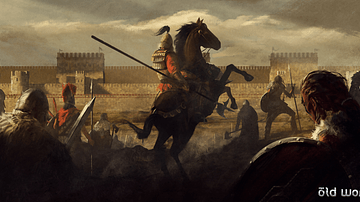
Artist's impression of an army in front of a large city wall, most likely during Late Antiquity or the early Middle Ages. While this does not depict any specific event, the walls may represent the Theodosian Walls of Constantinople...

Image
The Twelve Major Sieges of Constantinople (626–1453 CE) - War, Survival, and the Fall of the Byzantine Capital
The city of Constantinople, founded as an imperial capital by Constantine I in 330 CE, occupied a commanding position on the Bosporus between Europe and...
