
Search
Remove Ads
Advertisement
Search Results

Article
Aztec Food & Agriculture
The Aztec civilization, which flourished in central Mexico between c. 1345 and 1521 CE, was able to provide an astonishingly wide range of agricultural produce thanks to a combination of climatic advantages, diverse artificial...

Article
Ancient Korean & Japanese Relations
Ancient East Asia was dominated by the three states known today as China, Japan, and Korea. These kingdoms traded raw materials and high-quality manufactured goods, exchanged cultural ideas and practices, and fought...

Article
Ancient Japanese & Chinese Relations
Relations between ancient Japan and China have a long history, and in certain periods the exchange of political, religious and cultural practices between the two was intense. China, the much older state and the...
Article
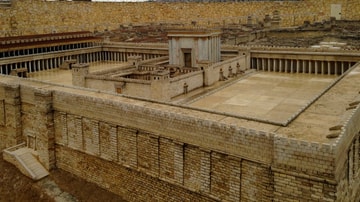
Early Judaism
During the period of early Judaism (6th century BCE - 70 CE), Judean religion began to develop ideas which diverged significantly from 10th-to-7th-centuries BCE Israelite and Judean religion. In particular, this period marks a significant...

Article
Siege Warfare in Medieval Europe
Siege tactics were a crucial part of medieval warfare, especially from the 11th century CE when castles became more widespread in Europe and sieges outnumbered pitched battles. Castles and fortified cities offered...

Article
Visitor’s Guide to the Monuments of Hadrian’s Villa
Hadrian’s Villa near Tivoli, Italy, is an opulent, sprawling garden-villa covering some 120 hectares (296 acres). It was built by Emperor Hadrian (76-138 CE) between 125-134 CE for use as his country...

Article
Ten Juneteenth Myths
The celebration of Juneteenth – originally known as "Freedom Day" – began on 1 January 1866 in Texas and, since then, a number of myths have grown up around the event it commemorates: the issuance of General Order No. 3 in...

Article
Nazca Pottery
The pottery of the Nazca civilization, which flourished in ancient Peru between 200 BCE and 600 CE, is amongst the most distinctive art produced by any civilization from antiquity. Endlessly inventive both in form and in its use...

Article
Silla Pottery
The pottery of ancient Korea stretches back to prehistory when simple brown wares were made and decorated with geometrical incisions and ends with the production of the superb celadons and white porcelain of the Goryeo dynasty but...

Article
Traveling Classroom History Exhibit
The best way to learn ancient history is not by memorizing dates and facts but, rather, through critical thinking and analysis. When studying ancient history, the key is to make inferences, using empathy and evaluation...
