
Search
Did you mean: Ugarit?
Remove Ads
Advertisement

 This answer was generated by
Search Results
Definition
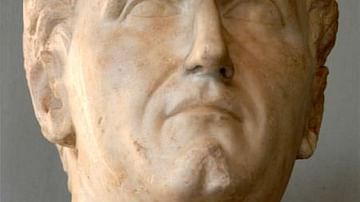
Nerva
Marcus Cocceius Nerva was Roman emperor from 96 to 98 CE, and his reign brought stability after the turbulent successions of his predecessors. In addition, Nerva helped establish the foundations for a new golden era for Rome which his...

Definition
Plautus
Titus Maccius Plautus, better known simply as Plautus (actually a nickname meaning 'flatfoot'), was, between c. 205 and 184 BCE, a Roman writer of comedy plays, specifically the fabulae palliatae, which had a Greek-themed storyline...

Definition
Vitruvius
Marcus Vitruvius Pollio (c. 90 - c. 20 BCE), better known simply as Vitruvius, was a Roman military engineer and architect who wrote De Architectura (On Architecture), a treatise which combines the history of ancient architecture and...

Definition
Roman Literature
The Roman Empire and its predecessor the Roman Republic produced an abundance of celebrated literature; poetry, comedies, dramas, histories, and philosophical tracts; the Romans avoided tragedies. Much of it survives to this day...
Definition
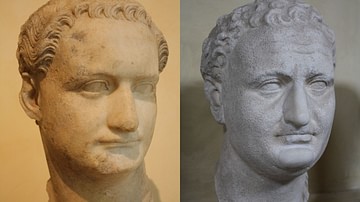
Suetonius
Gaius Suetonius Tranquillus (c. 69 – c. 130/140 CE), better known simply as Suetonius, was a Roman writer whose most famous work is his biographies of the first 12 Caesars. With a position close to the imperial court he was able to...
Definition
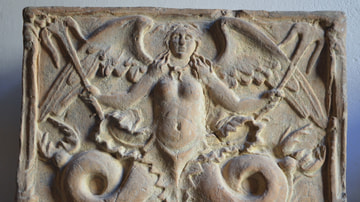
Ancient Volterra
Volterra (Etruscan name: Velathri, Roman: Volaterrae), located in the northern part of Tuscany, Italy, was an important Etruscan settlement between the 7th and 2nd century BCE. After its destruction by the Romans in the 1st century...

Definition
Pietro Perugino
Pietro Perugino (c. 1450-1523), real name Pietro di Cristoforo Vannucci, was an Italian Renaissance artist who created frescoes for the Vatican's Sistine Chapel and was in demand across Italy to decorate church interiors and produce...

Article
The Extent of the Roman Empire
Time has seen the rise and fall of a number of great empires - the Babylonian, the Assyrian, the Egyptian, and lastly, the Persian. Regardless of the size or skill of their army or the capabilities of their leaders...
Article
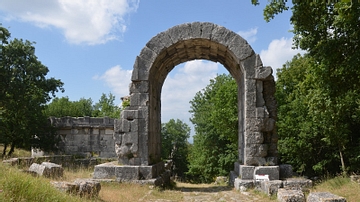
Visitor’s Guide to Carsulae (San Damiano)
Carsulae in Umbria, central Italy, was founded c. 300 BCE and only became a prosperous urban centre after it was connected by the Via Flaminia towards the end of the 3rd century BCE. It was granted the status...

Image
Emperor Claudius
Head from a colossal statue (twice life-size) of the Roman Emperor Claudius (ca. 50 CE) that stood in the forum of Carsulae (Umbria, Italy). Only the head and a knee of the statue survive.
