
Search
Did you mean: Thoth?
Remove Ads
Advertisement
Search Results

Article
Plato: The Name and The Poet
Plato (l. c. 424/423 to 348/347 BCE), the Greek philosopher whose works have significantly shaped Western thought and religion, is said to have initially been a poet and playwright and, even if the primary source of this claim (the often...

Definition
Ancient Egyptian Religion
Egyptian religion was a combination of beliefs and practices which, in the modern day, would include Egyptian mythology, science, medicine, psychiatry, magic, spiritualism, herbology, as well as the modern understanding of 'religion' as belief...

Definition
Zoroastrianism
Zoroastrianism is the monotheistic faith established by the Persian prophet Zoroaster (also given as Zarathustra, Zartosht) between c. 1500-1000 BCE. It holds that there is one supreme deity, Ahura Mazda (Lord of Wisdom), creator and sustainer...

Definition
Upanishads
The Upanishads are the philosophical-religious texts of Hinduism (also known as Sanatan Dharma meaning “Eternal Order” or “Eternal Path”) which develop and explain the fundamental tenets of the religion. The name is translated as to “sit...

Definition
Eratosthenes
Eratosthenes (l. c. 276-195 BCE) was a Greek astronomer, geographer, mathematician, and poet best known for being the first to calculate the circumference of the earth and its axial tilt. He is also recognized for his mathematical innovation...
Definition
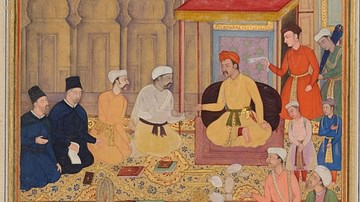
Ibadat Khana
The House of Worship or the Ibadat Khana was established by Mughal Emperor Akbar (1542-1605 CE) for conducting religious debates and discussions among theologians and professors of different religions. Abu'l-Fath Jalal-ud-din Muhammad Akbar...
Definition
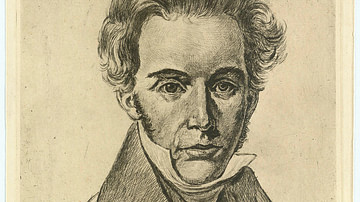
Søren Kierkegaard
Søren Kierkegaard (1813-1855) was a Danish philosopher and is considered to be the first existentialist, influencing such notable philosophers as Jean-Paul Sartre (1905-1980) and Martin Heidegger (1889-1976). His works are a reflection of...

Definition
Vardhamana
Vardhamana (l. c. 599-527 BCE), better known as Mahavira (“Great Hero”) is the sage credited with founding of the nontheistic religion of Jainism, a belief system established in the 6th and 5th centuries BCE in India, which provided adherents...

Article
Ancient Persian Gods, Heroes, and Creatures - The Complete List
The term 'mythology' comes from the Greek mythos (story-of-the-people) and logos (word or speech), meaning the spoken story of a people. Every civilization of the ancient world developed a belief system, which is characterized as 'mythology'...

Article
The Legend of Sargon of Akkad - Inspiration for the Story of Moses
The Legend of Sargon of Akkad (circa 2300 BCE) is an Akkadian work from Mesopotamia understood as the autobiography of Sargon of Akkad (Sargon the Great, reign 2334-2279 BCE), founder of the Akkadian Empire. The earliest copy is dated to...
