
Search
Remove Ads
Advertisement
Search Results

Definition
Visigoth
The Visigoths were the western tribe of the Goths (a Germanic people) who settled west of the Black Sea sometime in the 3rd century CE. According to the scholar Herwig Wolfram, the Roman writer Cassiodorus (c. 485-585 CE) coined the...

Definition
Sabratha
Sabratha was an ancient port city on the coast of North Africa (in modern-day Libya). The site was originally inhabited by the indigenous Berber Zwagha tribe in the 8th century BCE (according to the 11th-century CE historian al-Bakari...

Definition
Cleopatra VII - The Last Great Pharaoh of Ancient Egypt
Cleopatra VII (69-30 BCE, reign 51-30 BCE) was the last ruler of Egypt before it was annexed as a province of Rome. Arguably the most famous Egyptian queen, Cleopatra was ethnically Greek as a member...

Definition
Constantine VII
Constantine VII was Byzantine emperor from 945 until 959 CE. Sometimes known as Constantine Porphyrogennetos because of his birth in the purple chamber of the royal palace, he was served by various regents from 912 CE until reigning...
Definition
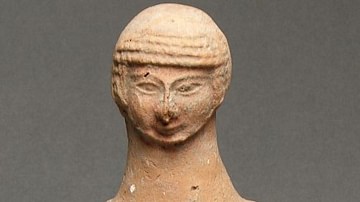
Asherah
Asherah is a Hebrew word for what was either a goddess or a cultic object or perhaps both. Although many see evidence for Asherah being an individual goddess known to the Israelites, some scholars believe that the context of the word...

Definition
Christopher Columbus
Christopher Columbus (l. 1451-1506 CE, also known as Cristoffa Corombo in Ligurian and Cristoforo Colombo in Italian) was a Genoese explorer (identified as Italian) who became famous in his own time as the man who discovered...

Definition
Proclus
Proclus of Athens (c. 412-485 CE) was a prolific Platonic philosopher whose main aim was the seemingly impossible task of defending traditional Greek polytheism at the time when his contemporary culture was almost completely dominated...

Definition
Hoenir
Hoenir or Hönir (Old Norse: Hœnir or Hønir) is a very shadowy god figure in Norse mythology, who joins the gods Loki and Odin on a couple of occasions in the old texts. He seems to have attributes of creation and prophecy, and his name...
Definition
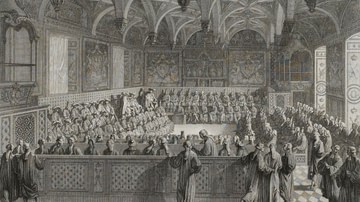
Revolt of the Parlements
The Revolt of the Parlements of 1787-1788, was the climax of a power struggle between the royal authority of King Louis XVI of France (r. 1774-1792) and the Parlement of Paris, the most powerful of France's thirteen parlements...
Definition
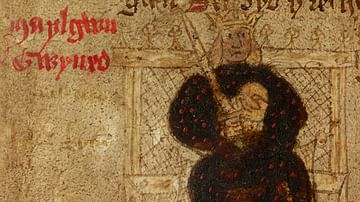
Maglocunus
Maglocunus, known as Maelgwn Gwynedd in Welsh (d. c. 547), was a 6th-century monarch based in Gwynedd, in north-western Wales. Maglocunus' name means "princely hound", and he expanded his influence to become one of the pre-eminent...
