
Search
Remove Ads
Advertisement
Search Results

Article
Death, Burial & the Afterlife in the Ancient Celtic Religion
The ancient Celts who occupied large parts of Europe from 700 BCE to 400 CE displayed a clear belief in an afterlife as evidenced in their treatment of the dead. In the absence of extensive written records by the Celts themselves, we are...

Definition
Jerusalem
Jerusalem is a major holy city for the three Western traditions of Judaism, Christianity, and Islam. It sits on spurs of bedrock between the Mediterranean Sea and the Dead Sea area. To the north and west, it tapers off to the Jezreel Valley...

Image
The Tomb of Tutankhamun (KV62), Thebes, c. 1323 BCE - The Boy King and the Tomb That Rewrote Egyptology
The tomb of Tutankhamun (c. 1345–1323 BCE; reign c. 1332–1323 BCE), located in the Valley of the Kings, offers a rare and largely intact snapshot of royal burial practice during Egypt’s New Kingdom (c. 1550–1070 BCE). Although Tutankhamun’s...
Image
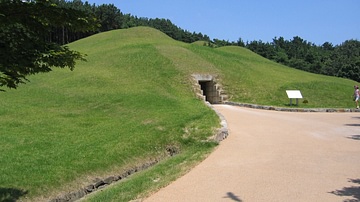
Tomb of Muryeong-Wang
The mound tomb of Baekje king Muryeong-Wang (r. 501-523 CE) which, within its huge earth mound, has a semi-circular vault lined with hundreds of moulded bricks, many decorated with lotus flower and geometric designs. The structure, located...
Image
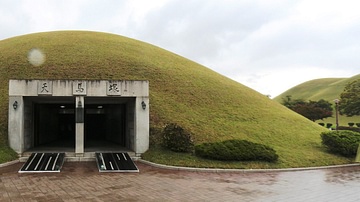
Cheonmachong ('Heavenly Horse Tomb')
The Silla royal tomb Cheonmachong ('Heavenly Horse Tomb'), Gyeongju, Korea. 6th century CE. The tomb was excavated in 1973 CE and, amongst hundreds of other treasures, contained a coffin, gold crown, jewellery pieces, and a painted horse...

Definition
Burial
Burial of the dead is the act of placing the corpse of a deceased person in a tomb constructed for that purpose or in a grave dug into the earth. Archaeological excavations have revealed Neanderthal graves dating back 130,000 years, marking...

Article
A Ghost Story of Ancient Egypt
The best-known ghost story from ancient Egypt is known, simply, as A Ghost Story but sometimes referenced as Khonsemhab and the Ghost. The story dates from the late New Kingdom of Egypt (c. 1570 - c.1069 BCE) and specifically the Ramesside...

Article
Warrior Women of the World of Ancient Macedon
The 8th November is celebrated as Archangels Day in Greece, but on that November day in 1977 CE something remarkable happened: an excavation team led by Professor Manolis Andronikos were roped down into the eerie gloom of an unlooted Macedonian-styled...
Article
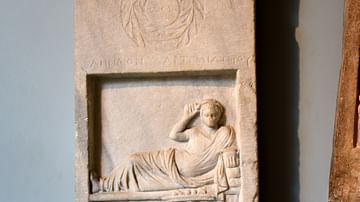
Curses & Fines on Epitaphs
The concept of a curse laid on a tomb or gravesite is best known from ancient Egypt but the practice was quite common in other civilizations of antiquity. The tomb or grave was the eternal home of the physical remains of the deceased to which...
Image
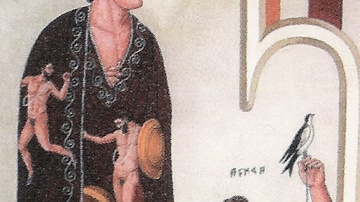
Vel Saties & Arnza, Francois Tomb
A watercolour painting of the scene from the wall painting of the Francois Tomb at Vulci showing Vel Saties and Arnza. The former is perhaps the tomb's occupant. 4th century BCE, Vulci, Italy. (Painting by C.Ruspi, Vatican Museums, Rome)
