
Search
Remove Ads
Advertisement
Search Results
Image
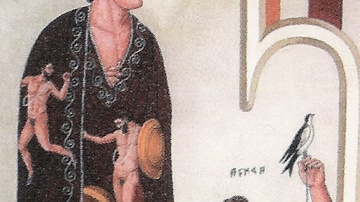
Vel Saties & Arnza, Francois Tomb
A watercolour painting of the scene from the wall painting of the Francois Tomb at Vulci showing Vel Saties and Arnza. The former is perhaps the tomb's occupant. 4th century BCE, Vulci, Italy. (Painting by C.Ruspi, Vatican Museums, Rome)
Image
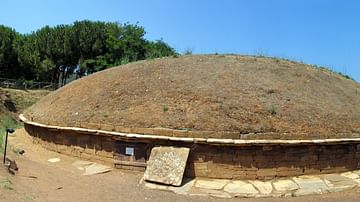
Tomb of the Chariots, Populonia
The Tomb of the Chariots at the Etruscan site of Populonia, north-west Italy. The side chambers of the tomb contained a chariot and two-wheeled carriage. Mid-7th to early 6th century BCE.
Image
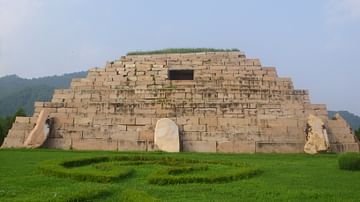
Tomb of Gwanggaeto the Great
The tomb of Goguryeo king Gwanggaeto the Great (r. 391–412 CE), aka the Tomb of the General, Korea. It measures 75 metres along the sides. The dolmen were originally placed at each of the four corners.

Image
Iron Peritrachelion (gorget) from Macedonian Tomb II of Vergina
Iron peritrachelion (gorget) with golden-silver decorative plate found in Macedonian Tomb II of Vergina, Imathia, Central Macedonia, Greece. The tomb is dated to between the end of the 4th century BCE and the beginning of the 3rd century...

Image
Hegra Tomb
Nabataean tomb at Hegra, photograph by the Royal Commission of AlUla, Saudi Arabia. A Nabataean tomb at the magnificent site of Hegra, AlUla, Saudi Arabia. Hegra was a massive site settled during the Nabatean and Roman times. A UNESCO World...

Image
Tomb Niche & Stela of Chnumit
Limestone tomb niche with a false-door stela and 2 side walls. From the tomb of princess Chnumit (also written Khnumet), Saqqara (Sakkara), modern-day Egypt. Old Kingdom, 6th Dynasty, circa 2200 BCE. (State Museum of Egyptian Art, Munich...

Article
The Gold Crowns of Silla
The Silla Kingdom ruled south-eastern Korea during the Three Kingdoms period (1st century BCE - 7th century CE) and then, as the Unified Silla Kingdom, all of Korea from 668 to 935 CE. The Silla produced fine pieces of art, but their most...

Article
Setna I: A Detailed Summary & Commentary
Setna I (also Setna Khaemaus and the Mummies) is a work of ancient Egyptian literature from the Ptolemaic Period (323-30 BCE) written in demotic script. It is part of a cycle of stories known as the Tales of Prince Setna featuring a character...

Article
The Roman Domus
The Roman domus was much more than a place of dwelling for a Roman familia. It also served as a place of business and a religious center for worship. The size of a domus could range from a very small house to a luxurious mansion. In some...

Video
King Tutankhamun and the Discovery of His Tomb
King Tutankhamun (or King Tut as he is known) spent the early years of his life with the name Tutankhaten and was born in the eleventh year of the reign of his father Pharaoh Amenhotep IV, who is better known as Akhenaten. While he was a...
