
Search
Remove Ads
Advertisement
Search Results

Definition
George I of Great Britain
George I of Great Britain (r. 1714-1727) succeeded the last of the Stuart monarchs, Queen Anne of Great Britain (r. 1702-1714) because he was Anne's nearest Protestant relative. The House of Hanover secured its position...
Article
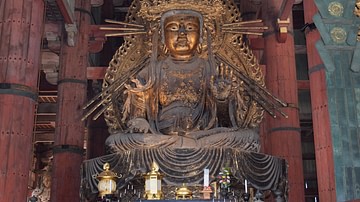
Buddhism in Ancient Japan
Buddhism was introduced to ancient Japan via Korea in the 6th century CE with various sects following in subsequent centuries via China. It was readily accepted by both the elite and ordinary populace because it confirmed...

Definition
Nara Period
The Nara Period (Nara Jidai) of ancient Japan (710-794 CE), so called because for most of that time the capital was located at Nara, then known as Heijokyo, was a short period of transition prior to the significant Heian Period. Despite...

Definition
Horyuji
The Horyuji Temple near Nara in Japan was founded in 607 CE by Prince Shotoku and is the only surviving Buddhist monastery from the Asuka Period in its original state. The complex, consisting of 48 listed buildings including a 5-storey...

Definition
Ancient Nara
Nara, located around 30 km south of modern Kyoto, was the capital of ancient Japan between 710 and 784 CE. It gave its name to the Nara Period (710-794 CE), although the name during the 8th century CE was Heijokyo. Modelled on the...

Definition
Yongle Emperor
The Yongle Emperor (aka Chengzu or Yung Lo, r. 1403-1424 CE) was the third ruler of the Chinese Ming Dynasty (1368-1644 CE). Inheriting a stable state thanks to the work of his father, the Hongwu Emperor (r. 1368-1398 CE), Yongle...

Definition
Golden Horde
The Golden Horde was the European appanage of the Mongol Empire (1206-1368 CE). Begun in earnest by Batu Khan in 1227 CE, the territory that would eventually become the Golden Horde came to encompass parts of Central Asia, much of...

Definition
Script - The Written Record of Humanity
Script is the written expression of a language. Cuneiform, the first script, was invented in Sumer, Mesopotamia, circa 3600/3500 BCE; hieroglyphics sometime prior to the Early Dynastic Period in Egypt (circa...

Definition
Siddhartha Gautama
Siddhartha Gautama (better known as the Buddha, l. c. 563 - c. 483 BCE) was, according to legend, a Hindu prince who renounced his position and wealth to seek enlightenment as a spiritual ascetic, attained his goal and, in preaching...
Definition
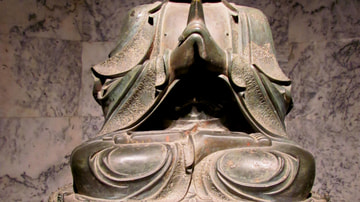
Esoteric Buddhism
Esoteric Buddhism is the mystical interpretation and practice of the belief system founded by the Buddha (known as Sakyamuni Buddha, l. c. 563 - c. 483 BCE). It is known by several names and is characterized by a personal relationship...
