
Search
Remove Ads
Advertisement
Search Results

Definition
Civil Constitution of the Clergy
The Civil Constitution of the Clergy was a law passed in July 1790 during the French Revolution (1789-1799), which caused the immediate subordination of the Catholic Church in France to the French government. An attempt...

Definition
Henry Lee III
Henry Lee III (1756-1818), more commonly known by his nickname 'Light-Horse Harry' Lee, was a cavalry officer in the Continental Army during the American Revolutionary War (1775-1783) and a politician who served as the ninth Governor...
Definition
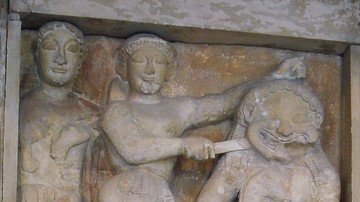
Perseus
Perseus is one of the greatest and oldest pan-Hellenic heroes of Greek mythology. Perseus famously killed the dreaded Medusa, a Gorgon with snakes as hair and whose stare turned men to stone. Perseus also carried out the daring rescue...

Definition
Pluto
Pluto is the god of the Underworld in Roman mythology. His Greek counterpart was Hades. Pluto chose never to sit on Olympus with the other gods and goddesses, preferring to remain in the Underworld. Family Pluto (Hades) was the son...

Definition
Saint Patrick
Saint Patrick (5th century) is the best-known patron saint of Ireland and one of the most successful Christian missionaries in history. He is credited with expanding literacy in Ireland through the monastic orders he established...

Definition
Four Noble Truths
The Four Noble Truths are the foundational tenets of Buddhism, which spark awareness of suffering as the nature of existence, its cause, and how to live without it. The truths are understood as the realization which led to the...

Definition
Grossmunster
Grossmünster (“large cathedral” in German) is a Romanesque ex-cathedral situated in the heart of Zürich, Switzerland, which was built over the course of the 11th and 13th centuries CE. According to legend, the Holy Roman Emperor...

Definition
Fenrir
Fenrir is the great wolf in Norse Mythology who breaks free from his chains at Ragnarök, the twilight of the gods, kills Odin, and is then killed by Odin’s son Vidarr. Fenrir is the son of the trickster god Loki and brother of the World...

Definition
French and Indian War - The Final Clash of Empires in North America
The French and Indian War (1754-1763) was the last great colonial conflict waged between Great Britain and France in North America. Often considered a theater of the global Seven Years'...

Definition
Napoleon's Invasion of Russia
Napoleon's invasion of Russia, also known as the Second Polish War or, in Russia, as the Patriotic War of 1812, was a campaign undertaken by French Emperor Napoleon I (r. 1804-1814; 1815) and his 615,000-man Grande...
