
Search
Remove Ads
Advertisement
Search Results

Definition
Dunkirk Evacuation
The Dunkirk Evacuation of 26 May to 4 June 1940, known as Operation Dynamo, was the attempt to save the British Expeditionary Force in France from total defeat by an advancing German army. Nearly 1,000 naval and civilian craft...

Definition
Socrates
Socrates of Athens (l. c. 470/469-399 BCE) is among the most famous figures in world history for his contributions to the development of ancient Greek philosophy which provided the foundation for all of Western Philosophy. He is, in...

Definition
Byzantine Emperor
The Byzantine Emperor ruled as an absolute monarch in an institution which lasted from the 4th to 15th century CE. Aided by ministers, high-ranking nobility, and key church figures, the emperor (and sometimes empress) was commander-in-chief...

Definition
Excalibur
Excalibur is the sword of King Arthur in Sir Thomas Malory's iconic work Le Morte D'Arthur published in in 1485 CE. The sword was originally introduced in Geoffrey of Monmouth's History of the Kings of Britain (1136 CE) as Caliburnus...

Definition
English Reformation
The English Reformation began with Henry VIII of England (r. 1509-1547 CE) and continued in stages over the rest of the 16th century CE. The process witnessed the break away from the Catholic Church headed by the Pope in Rome...

Definition
Adam Smith
Adam Smith (1723-1790) was a Scottish philosopher, economist, and leading Enlightenment figure. In The Wealth of Nations, he advocates free trade and limited interference in markets by governments, for which he is seen as the founder...
Definition
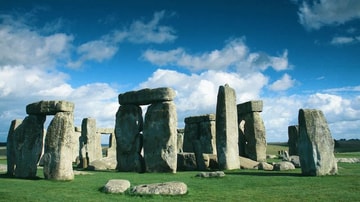
Stonehenge
Stonehenge is a Neolithic / Bronze Age monument located on Salisbury Plain, Wiltshire, southern England. The first monument on the site, began around 3100 BCE, was a circular 'henge' earthwork about 360 feet (110 metres) in diameter...

Definition
Works and Days
Works and Days is an epic poem written in dactylic hexameter, credited to the 8th-century BCE Greek poet Hesiod. Hesiod is generally remembered for two epic works, Theogony and Works and Days but, like his contemporary Homer, he...
Definition
Pontius Pilate
Pontius Pilate was the fifth magistrate to serve in the Roman province of Judea, created in 6 CE by Roman emperor Augustus (r. 27 BCE to 14 CE). His term of office was during the subsequent reign of Tiberius from 26-36 CE. He became...

Article
The Report of Wenamun: Text & Commentary
The literature of the Middle Kingdom of Egypt (2040-1782 BCE) is justly famous as some of the best the culture ever produced. Great works like The Tale of the Shipwrecked Sailor and The Tale of Sinuhe stand...
