
Search
Remove Ads
Advertisement
Search Results
Definition
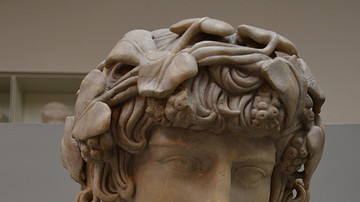
Antinous
Antinous (l. c. 110-130 CE) was a youth of Bithynia who became the beloved of the Roman emperor Hadrian (l. 76-138 CE, r. 117-138 CE) from around the age of 13 until his death at nearly 20. His year of birth is unknown as are any details...

Definition
Alaric
Alaric I (r. 394-410 CE) was a Gothic military commander who is famous for sacking Rome in 410 CE, which was the first time the city had been sacked in over 800 years. Although little of his family is known, we do know that he became...

Definition
Fritigern
Fritigern (also Fritigernus, died c. 380 CE) was a Visigothic king best known as the victor of the decisive Battle of Adrianople in 378 CE, which decimated the Roman army and haunted Roman military commanders for decades afterwards...

Image
Map of the Growth of Christianity in the Roman Empire
The rise and spread of Christianity (1st–5th centuries CE) traces the transformation of a small, decentralized religious movement in Roman Judea into a faith that reshaped the political, social, and...
Image
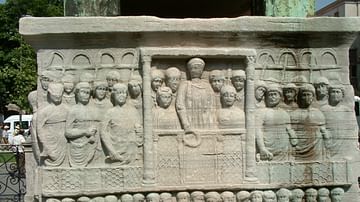
Roman Emperor at the Hippodrome
A relief scene showing a Roman emperor (probably Theodosius I) with his entourage in the royal box at the Hippodrome of Constantinople. From the 4th century CE base of the column of the obelisk of Thutmose III which...

Article
Constantine’s Conversion to Christianity
Constantine I (Flavius Valerius Constantinus) was Roman emperor from 306-337 CE and is known to history as Constantine the Great for his conversion to Christianity in 312 CE and his subsequent Christianization...

Article
Gods & Goddesses of Ancient Egypt - A Brief History
The land of ancient Egypt was alive with the spirit of the gods. The sun god Ra broke from the darkness every morning in his great boat, bringing the light, and many of the gods watched over the people...

Article
Passing of Philosophy to Religion: The Death of Hypatia
The death of the philosopher Hypatia of Alexandria (l. c. 370-415) has long been considered the "passage of philosophy to religion", exemplifying the transition from the pagan values of antiquity...

Article
Byzantine-Armenian Relations
The relationship between the Byzantine Empire and ancient Armenia was a constant and varied one with an equal mix of wars, occupations, treaties of friendship, mutual military aid, and cultural exchange. Regarded as...

Video
Ten Minute History - The Fall of Rome (Short Documentary)
This episode of Ten Minute History (like a documentary, only shorter) covers the decline and fall of the Western Roman Empire. It deals with the division of the empire by Theodosius I and the rule...
