
Search
Remove Ads
Advertisement
Search Results

Definition
Theodosian Walls
The Theodosian Walls are the fortifications of Constantinople, capital of the Byzantine Empire, which were first built during the reign of Theodosius II (408-450 CE). Sometimes known as the Theodosian Long Walls, they built upon...

Definition
Stilicho
Flavius Stilicho (365-408 CE) was a Roman army commander, who rose in the ranks under the reign of Roman emperor Theodosius I (r. 378-395 CE) and eventually became the regent to his son Honorius (r. 395-423 CE). Stilicho fought with...

Definition
Attila the Hun
Attila the Hun (r. 434-453 CE) was the leader of the ancient nomadic people known as the Huns and ruler of the Hunnic Empire, which he established. His name means "Little Father" and, according to some historians, may not have...

Definition
Constantinople
Built in the seventh century BCE, the ancient city of Byzantium proved to be a valuable city for both the Greeks and Romans. Because it lay on the European side of the Strait of Bosporus, the Emperor Constantine understood its...

Definition
Orosius - Great Defender of Christianity Against the Pagans
Paulus Orosius (usually given as Orosius, 5th century) was a Christian theologian and historian who was also a friend and protege of Saint Augustine of Hippo (354-430). He is best known for his...

Article
Sack of Rome 410 CE
In August of 410 CE Alaric the Gothic king accomplished something that had not been done in over eight centuries: he and his army entered the gates of imperial Rome and sacked the city. Although the city and, for a time, the...
Article
Famous Grammarians & Poets of the Byzantine Empire
In the wake of the downfall of the Western Roman Empire and the intellectual collapse of Athens, Byzantine scholars engaged in preserving the Classical Greek language and its literature. Thus they became...

Definition
Roman Empire
The Roman Empire, at its height (c. 117), was the most extensive political and social structure in western civilization. Building upon the foundation laid by the Roman Republic, the empire became the largest and most powerful political...
Definition
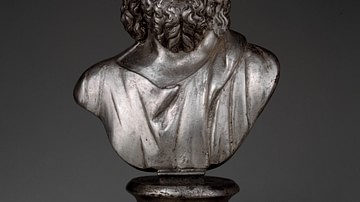
Serapis
Serapis is a Graeco-Egyptian god of the Ptolemaic Period (323-30 BCE) of Egypt developed by the monarch Ptolemy I Soter (r. 305-282 BCE) as part of his vision to unite his Egyptian and Greek subjects. Serapis’ cult later spread throughout...

Article
Christian Antisemitism in the Middle Ages & during the Reformation
Antisemitism is a modern term that describes prejudice and hostility to Jews and Judaism. The origins of Christian antisemitism in the gospels are based on the story of a 1st-century itinerant...
