
Search
Remove Ads
Advertisement
Search Results

Definition
Camille Pissarro
Camille Pissarro (1830-1903) was an impressionist painter based in France who focussed on landscapes but frequently changed his style and subjects. He was an instrumental figure in the new art movement of the 19th century, organising...
Definition
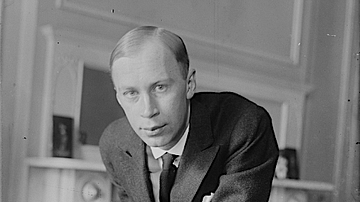
Sergei Prokofiev
Sergei Prokofiev (1891-1953) was a Russian composer (born in Ukraine) who was at the forefront of the Modernist music movement. His symphonies, orchestral suites, and ballets display endless variety and complexity. His most famous...

Definition
League of Nations
The League of Nations was founded in January 1920 to promote world peace and welfare. Created by the Treaty of Versailles, which formally ended the First World War (1914-18), the League provided a forum where nations promised...

Definition
Roman Warfare
Roman warfare was remarkably successful over many centuries and across many territories. This was due to several important factors. Italy was a peninsula not easily attacked, there was a huge pool of fighting men to draw upon, a...

Definition
January Uprising of 1863 - Polish Rebellion Against Russian Rule in Poland
The January Uprising of 1863 was a conflict between Tsarist Russia and Polish insurgents striving for independence. The uprising continued until October 1864, when it was suppressed...

Definition
Mithraism
The Mithraic Mysteries, also known as Mithraism, were a mystery cult in the Roman world where followers worshipped the Indo-Iranian deity Mithras (Akkadian for "contract") as the god of friendship, contract and order. The cult first...

Definition
Muse
In Greek mythology, the nine Muses are goddesses of the various arts such as music, dance, and poetry. Blessed with wonderful artistic talents, they also possess great beauty, grace, and allure. Their gifts of song, dance, and joy helped...

Definition
Samurai
The samurai (also bushi) were a class of warriors that arose in the 10th century in Japan and which performed military service until the 19th century. Elite and highly-trained soldiers adept at using both the bow and sword, the samurai...

Definition
Muromachi Period
The Muromachi Period (Muromachi Jidai, 1333-1573 CE) refers to the period of Japanese medieval history when the Ashikaga shogun capital was located in the Muromachi area of Heiankyo (Kyoto). Replacing the Kamakura Shogunate (1192-1333...

Definition
Byzantine Architecture
The architecture of the Byzantine Empire (4th - 15th century CE) continued its early Roman traditions but architects also added new structures to their already formidable repertoire, notably improved fortification walls and...
