
Search
Remove Ads
Advertisement
Search Results

Article
The Olive in the Ancient Mediterranean
Olives and olive oil were not only an important component of the ancient Mediterranean diet but also one of the most successful industries in antiquity. Cultivation of the olive spread with Phoenician and Greek colonization from Asia Minor...
Article
Olive Branch Petition
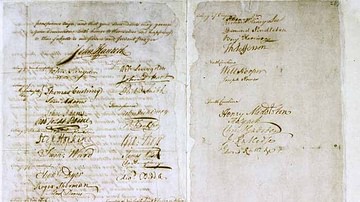
The Olive Branch Petition was a letter adopted by the Second Continental Congress on 5 July 1775 and sent to King George III of Great Britain (r. 1760-1820) in a final attempt at reconciliation in the early months of the American Revolutionary...

Definition
Pirates in the Ancient Mediterranean
Piracy, defined as the act of attacking and robbing a ship or port by sea, had a long history in the ancient Mediterranean stretching from the time of the Egyptian pharaoh Akhenaten (r. 1353-1336 BCE) and throughout the Middle Ages (c. 476-1500...

Article
North Africa’s Place in the Mediterranean Economy of Late Antiquity
The Mediterranean Sea was the economic focal point of the Roman Empire. Rome's armies first established an empire across these waters beginning back in the times of the Roman Republic. In 200 CE, the Mediterranean was still the channel that...

Article
The Rise of Cities in the Ancient Mediterranean
The history of the ancient world has always been told as a history of cities, from Homer's epic poems about events just before and just after the sack of Troy, through the prose histories of wars between Athens and Sparta, Rome and Carthage...

Article
Caesarea Maritima's Role in the Mediterranean Trade
Caesarea Maritima was located on the eastern coast of the Mediterranean Sea. Built from the ground up in 22-10 BCE by Rome's client king, Herod the Great (r. 37-4 BCE), its location in relation to ship traffic and proximity to historical...

Article
Paul's Journeys and the Mediterranean Trade
Mediterranean trade increased exponentially at the turn of the first millennium. During Rome's zenith, goods of all sorts began to move in all directions. As a common traveler aboard merchant ships, Paul traveled within such a milieu. Tracing...

Article
Pirates of the Mediterranean
The pirates of the ancient Mediterranean were not, for the most part, the outsiders who knew no country's allegiance and were the enemies of civilization as they are frequently depicted in novels and other media. They were often employed...

Article
Wine in the Ancient Mediterranean
Wine was the most popular manufactured drink in the ancient Mediterranean. With a rich mythology, everyday consumption, and important role in rituals wine would spread via the colonization process to regions all around the Mediterranean coastal...

Article
Wine Culture in the Hellenistic Mediterranean
The culture of drinking wine was enjoyed throughout the Mediterranean world, and what is true now was true in antiquity, too: wine is always good business. The Hellenistic Period (c. 335-30 BCE), between Alexander the Great and Cleopatra...
