
Search
Remove Ads
Advertisement
Search Results

Image
Siege of Rhodes, 305-304 BCE
Illustration of the Siege of Rhodes (305-304 BCE) by Zvonimir Grbasic. Courtesy of Ancient Warfare Magazine / Karwansaray Publishers.
Image
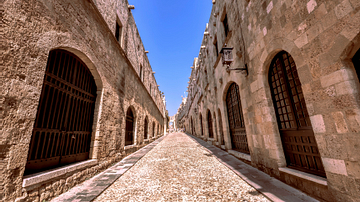
The Street of Knights, Rhodes
The living quarters of the holy warriors, commonly known as the Knights Hospitaller, line the Street of Knights in the old town of Rhodes.
Image
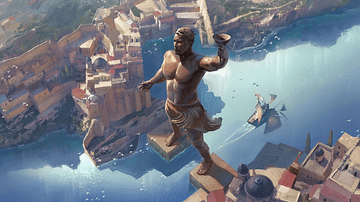
Greco-Roman Colossus (Artist's Impression)
An artist's depiction of a Greco-Roman colossal statue. From the game Old World.

Image
The Colossus of Constantine
Once located in the west apse of the Basilica of Maxentius, fragments of the Colossus of Constantine are now located in the courtyard of the Palazzo dei Conservatori of the Musei Capitolini on the Capitoline Hill, Rome. Marble, 312 CE.
Image
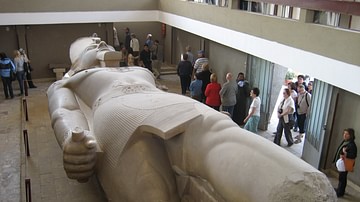
Colossus of Ramesses II
Colossus of Ramesses II in Memphis, Egypt.
Image
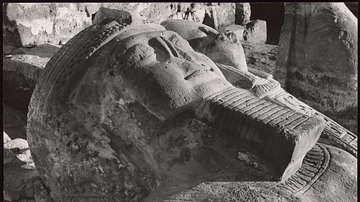
Head of a Colossus, Wadi es Sebui, Nubia
Wadi es Sebui (94 miles north of Aswan, left bank). Temple of Amon Ra and Ra Horakhti built during the reign of Rameses II (1290-1223 BCE). The fallen head of a colossus lies before the pylon of the temple. The statues, sphinxes and reliefs...
Image
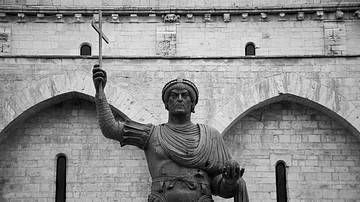
Colossus of Barletta
The Colossus of Barletta, thought to depict Byzantine emperor Leo I (r. 457-474 CE). Removed from Constantinople in 1204 CE, it was lost in a shipwreck off the coast of Barletta, southern Italy.
Image
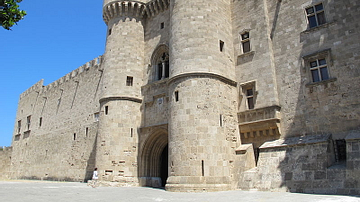
Main Entrance, Palace of the Masters, Rhodes
The main entrance to the Palace of the Masters of the Knights Hospitaller or Knights of Rhodes. 14th century CE.

Definition
Pirates in the Ancient Mediterranean
Piracy, defined as the act of attacking and robbing a ship or port by sea, had a long history in the ancient Mediterranean stretching from the time of the Egyptian pharaoh Akhenaten (r. 1353-1336 BCE) and throughout the Middle Ages (c. 476-1500...
Image
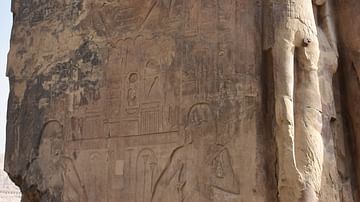
Side Panel, Colossus of Memnon
A side panel from one of the two figures known as the Colossi of Memnon representing Amenhotep III, 18th Dynasty, 14th century BCE. Either side of the panel are figures of
Hapi and Tiy. Luxor, Egypt.
