
Search
Remove Ads
Advertisement
Search Results

Article
Early Judaism
During the period of early Judaism (6th century BCE - 70 CE), Judean religion began to develop ideas which diverged significantly from 10th-to-7th-centuries BCE Israelite and Judean religion. In particular, this period marks a significant...

Definition
Illuminated Manuscripts
Illuminated manuscripts were hand-made books, usually on Christian scripture or practice, produced in Western Europe between c. 500-c. 1600. They are so called because of the use of gold and silver which illuminates the text and accompanying...

Article
Setna I: A Detailed Summary & Commentary
Setna I (also Setna Khaemaus and the Mummies) is a work of ancient Egyptian literature from the Ptolemaic Period (323-30 BCE) written in demotic script. It is part of a cycle of stories known as the Tales of Prince Setna featuring a character...

Article
Twelve Greatest Illuminated Manuscripts
Illuminated manuscripts are, as their name suggests, hand-made books illumined by gold and silver ink. They were produced in Western Europe between c. 500 and c. 1600 CE and their subject matter is usually Christian scripture, practice, and...
Definition
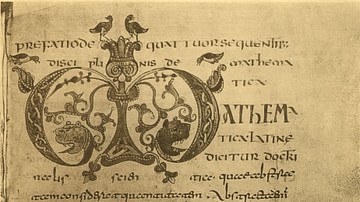
Etymologiae
The Etymologiae (Etymologies) is a Latin work by Isidore of Seville (l. c. 560 - 636 CE), compiled in the early 7th century CE and published in its final form shortly after his death. The book is a type of medieval encyclopedia and is a survey...

Definition
Iliad
Homer's Iliad describes the final year of the Trojan War, a legendary conflict between an alliance of Greek cities and the city of Troy in Anatolia. It was probably written in the 8th century BCE after a long oral tradition. The Greeks themselves...

Image
Great Domesday Book
Domesday Book is actually composed of two volumes, with here shown the larger of the two, the Great Domesday book. Compiled in 1086-7 CE by William the Conqueror as a survey of land and property ownership across Norman England. (National...

Image
Geb & Nut, Book of the Dead
A detail of the Book of the Dead of Henuttawy, depicting the goddess Nut arched over the god Geb. Geb is depicted with the head of a snake. The full papyrus measures 74 cm x 23 cm (29 in x 9 in). Egypt. Third Intermediate Period (c. 1069-525...
Image
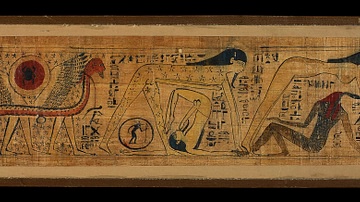
Book of the Dead of Henuttawy
The Book of the Dead of Henuttawy. The winged serpent god Nehebkau is depicted on the left. In the center of the papyrus is Osiris, who lies beneath the personification of the night sky. On the right side of the scene, the goddess Nut arches...

Image
Book of the Dead of Aaneru, Thebes
A detail from the Book of the Dead of Aaneru from Thebes, Third Intermediate Period of Egypt, 21st Dynasty, 1070-946 BCE.
Egyptian Museum, Turin.
