
Search
Remove Ads
Advertisement
Search Results

Image
Ninmah Temple
Ninmah Temple appears behind ruins of a low-lying flat building (which is thought to represent an altar). Modern reconstruction, Babylon.
Image
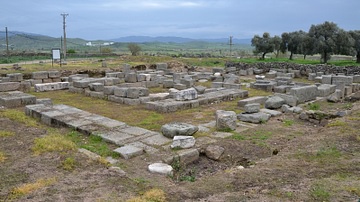
Ionic Temple of Apollo Isotimos
The ruins of the Ionic Temple of Apollo Isotimos in Alabanda, built in the 2nd century BC.

Image
Piravasthalam Pallava Temple, Kanchipuram
Relief of Shiva on the wall of the Piravasthalam Temple, Kanchipuram, India. 720 CE.

Image
Vaikuntanathaperumal Temple, Kanchipuram
Vaikuntanathaperumal Temple, Kanchipuram, India. Late 8th century CE.

Image
Temple Relief of Akhenaten
The Egyptian pharaoh Akhenaten (r. 1353-1336 BCE) appears beneath the rays of god Aten. Painted sandstone. New Kingdom, 18th Dynasty, c. 1350 BCE. From the Temple of Aten at Karnak, Egypt. (The Neues Museum, Berlin, Germany...

Image
Atlantide, Temple of Zeus, Agrigento
One of the massive atlantide figures from the temple of Zeus (480s BCE) in Agrigento. There were 38 such figures incorporated into the architecture of the building and each stood 7.6 metres tall. (Archaeological...
Image
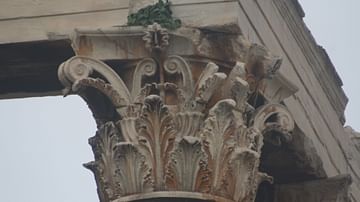
Corinthian Capital, Temple of Zeus, Athens
A Corinthian capital from the Temple of Olympian Zeus, Athens. Completed 131 CE.
Definition
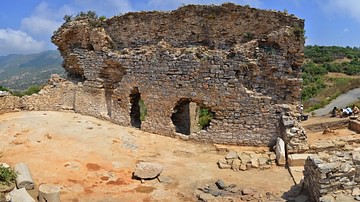
Antiochia ad Cragum
Antiochia ad Cragum (“Antioch on the Cliffs” or “Antioch at Cragus”) was a Hellenistic Roman city located in Cilicia Trachea (“Rough Cilicia”, also known as Cilicia Aspera and Cilicia Secunda) on the southern coast of modern-day...

Article
Festivals in Ancient Egypt
The gods of the ancient Egyptians were always apparent to the people through natural events. The sunrise was Ra emerging from the underworld in his great ship, for example, and the moon was the god Khonsu traveling across...

Collection
Julio-Claudian Dynasty
The Julio-Claudian dynasty is the collective name given to the first five emperors of the ancient Roman Empire. The name of the dynasty derives from the names of the two families from which its members came: the Julii Caesares...
