
Search
Did you mean: Sepoy?
Remove Ads
Advertisement
Search Results

Article
The Germanic Warrior - Loyalty Unto Death
In Germanic society, the surest route to wealth, status and power was success in battle. Its most important institution was the comitatus or war band, the personal retinue of elite warriors that every king or chief tried to gather around...

Article
Ancient Mesopotamian Beliefs in the Afterlife
Unlike the rich corpus of ancient Egyptian funerary texts, no such “guidebooks” from Mesopotamia detail the afterlife and the soul's fate after death. Instead, ancient Mesopotamian views of the afterlife must be pieced together from a variety...

Article
Saladin's Conquest of Jerusalem (1187 CE)
Jerusalem, a holy city for the adherents of all three great monotheistic religions (Judaism, Christianity, and Islam) was conquered by the armies of the First Crusade in 1099 CE. The Muslims failed to halt their advance, as they were themselves...

Article
The Death of Ur-Nammu - The Sumerian Vision of the Afterlife
The Death of Ur-Nammu is a Sumerian lament over the passing of the king Ur-Nammu (reign circa 2112-2094 BCE), founder of the Third Dynasty of Ur, who was killed in battle fighting the Gutians in 2094 BCE. The poem is frequently cited for...

Article
The Armies of the Crusades
The armies of the Crusades (11th-15th centuries CE), which saw Christians and Muslims struggle for control of territories in the Middle East and elsewhere, could involve over 100,000 men on either side who came from all over Europe to form...

Article
Battles & Conquests Of The Ottoman Empire (1299-1683)
Spanning across three continents and holding dominance over the Black and Mediterranean Seas, the Ottoman Sultanate (1299-1922) was a global military superpower between the 15th and 17th centuries. From the point of its inception in 1299...

Article
Ancient Korean & Japanese Relations
Ancient East Asia was dominated by the three states known today as China, Japan, and Korea. These kingdoms traded raw materials and high-quality manufactured goods, exchanged cultural ideas and practices, and fought each other in equal measure...
Article
Trade & Warfare in the Kievan Rus
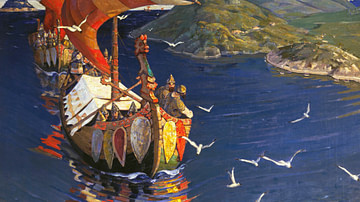
Scandinavians from the island of Gotland began to spread throughout the Baltic region along the Russian rivers in the 700s. While the Vikings of Norway and Denmark from the 8th to 11th centuries are widely recognized as fearsome raiders and...

Article
Fortifications in Ancient Chinese Warfare
While ancient Chinese warfare was often characterised by large armies in pitched battles, siege warfare and the sacking of cities were also regular features. Huge earth walls with towers and encircling ditches or moats became the normal strategy...
Article
Cavalry in Ancient Chinese Warfare
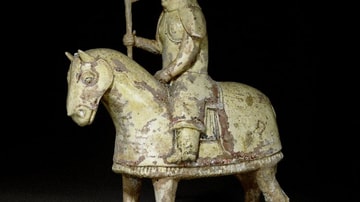
The use of cavalry in Chinese warfare was a significant development which was largely responsible for the abandonment of chariots, that vehicle being much slower and more cumbersome to manoeuvre in battle conditions. The greater speed and...
