
Search
Did you mean: Sepoy?
Remove Ads
Advertisement
Search Results
Article
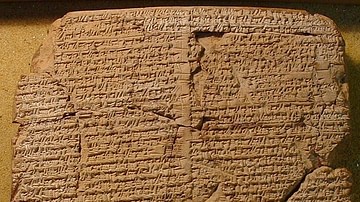
Ancient Mesopotamian Ghost Spell - Keeping the Dead Where They Belong
Medicine in ancient Mesopotamia was based on the belief that illness was caused by supernatural agencies and, although medicines were given and injuries treated, magical spells and incantations were also understood as effective. Among these...

Article
Byzantine-Armenian Relations
The relationship between the Byzantine Empire and ancient Armenia was a constant and varied one with an equal mix of wars, occupations, treaties of friendship, mutual military aid, and cultural exchange. Regarded as a vital defence to the...

Article
Parthia: Rome's Ablest Competitor
As a superpower in its own right and in competition with Rome, Parthia's empire - ruling from 247 BCE to 224 CE - stretched between the Mediterranean in the west to India in the east. Not only did the Parthians win battles against Rome they...

Video
History of the Scythians: an Ancient Nomadic Culture
The Scythians were a nomadic culture that flourished between the seventh and the third centuries BCE, as their territory expanded from Thrace in the west across the Central Asian Steppe (a steppe is basically just an open swathe of grassland...

Collection
Genghis Khan & the Mongol Empire
Through the 13th and 14th century CE the Mongols forged the largest connected empire the world had ever seen and such figures as Genghis Khan and Kublai Khan were feared as the devil himself, their mounted warriors conquering for their leaders...

Image
Map of the Silk Road During the Late 8th Century
In the late 8th century CE, the interconnected caravan routes later termed the “Silk Road” formed a transcontinental system linking East Asia, Central Asia, the Islamic world, and parts of Europe. The label “Silk Road” (German: Seidenstraße...

Image
Map of the Empire of the Huns under Attila, c. 450 CE - Power, Pressure, and Collapse in Late Antiquity
The rise of the Huns in the 5th century CE reshaped the political landscape of Late Antiquity, culminating under Attila the Hun (reign 434-453 CE). Emerging from the Eurasian steppe, the Huns did not form a centralized territorial state in...

Image
Map of the Russian Empire on the Eve of World War I, 1914 - A Eurasian Giant at the Brink
The Russian Empire on the eve of World War I (1914) represented the largest contiguous empire in modern history, stretching from Eastern Europe across Siberia to the Pacific Ocean. Its territorial scale was the result of gradual expansion...

Image
Map of the Median Hegemony, c. 600 BCE - Power, Influence & Transition in Western Asia after Assyria
The Median hegemony (late 7th-early 6th century BCE) emerged in the aftermath of the Bronze Age Collapse (c. 1200-1150 BCE) and, more directly, the disintegration of the Neo-Assyrian Empire (to 612/609 BCE). Under rulers such as Cyaxares...

Image
Map of the Migration Period in Europe in the 4th-5th Century
The Migration Period in Europe (c. 4th–6th centuries CE) marks a prolonged era of movement, conflict, and political transformation rather than a single moment of collapse. Following the death of Emperor Theodosius I (reign 379–395 CE) and...
