
Search
Did you mean: Oshun?
Remove Ads
Advertisement
Search Results
Image
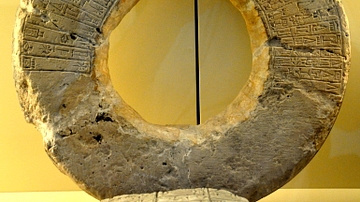
Cuneiform Inscribed Well Curb
A stone ring of a well curb with cuneiform inscriptions which mention the name of the king Shu-Sin of Ur. Ur III, 2030 BCE. From southern Mesopotamia, Iraq. (The Pergamon Museum).

Article
The Art of the Amarna Period
Of all the pharaohs who ruled ancient Egypt, there is one in particular that stands out from the rest. Over the course of his 17-year reign (1353-1336 BCE), Akhenaten spearheaded a cultural, religious, and artistic revolution...

Article
Song of Everlasting Sorrow
The Song of Everlasting Sorrow is a narrative poem of the Tang Dynasty (618-907 CE) inspired by the love affair between Xuanzong (r. 712-756 CE), the seventh emperor of the dynasty, and his consort Lady Yang. It was written...

Article
Lullaby for a Son of Shulgi - A Single Moment Preserved in Time
Lullaby for a Son of Shulgi is a Sumerian cradlesong from the reign of Shulgi of Ur (2094 to circa 2046 BCE) written for one of his sons. The lullaby follows a standard form of encouraging...

Definition
Cuneiform - The Writing System That Made History
Cuneiform is a system of writing first developed by the ancient Sumerians of Mesopotamia circa 3600/3500 BCE. It is considered the most significant among the many cultural contributions of the Sumerians...

Definition
Ancient Egyptian Culture
Ancient Egyptian culture flourished between c. 6000 BCE with the rise of technology (as evidenced in the glasswork of faience) and 30 BCE with the death of Cleopatra VII, the last Ptolemaic ruler of Egypt. It is famous...

Definition
Religion in the Ancient World - Order and the Spiritual Experience
Religion (from the Latin Religio, meaning "restraint," or Relegere, according to Cicero, meaning "to repeat, to read again," or, most likely, Religionem, "to show respect for what is sacred"...

Definition
Han Dynasty
The Han Dynasty (202 BCE - 220 CE) was the second dynasty of Imperial China (the era of centralized, dynastic government, 221 BCE - 1912 CE) which established the paradigm for all succeeding dynasties up through 1912 CE. It succeeded...

Definition
Ancient Chinese Art
Ancient China covered a vast and ever-changing geopolitical landscape, and the art it produced over three millennia is, unsurprisingly, just as varied. Still, despite continuous indigenous technical developments, changes in...

Definition
Warring States Period
The Warring States period (481/403 BCE - 221 BCE) describes the three centuries when various rival Chinese states battled viciously for territorial advantage and dominance. Ultimately the Qin state was victorious and established...
