
Search
Did you mean: Ashvins?
Remove Ads
Advertisement
Search Results
Definition
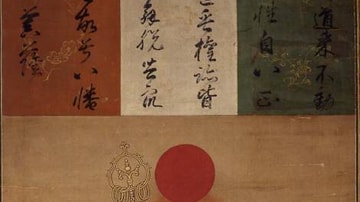
Hachiman - Origin of the Kamikaze Wind
Hachiman is the ancient Shinto god or kami of war, divination, and culture. He is famously credited with sending the kamikaze or 'divine wind' which twice dispersed the invading fleets of Mongol ruler Kublai Khan...

Article
Enuma Elish - The Babylonian Epic of Creation - Full Text
The Enuma Elish (also known as The Seven Tablets of Creation) is the Babylonian creation myth whose title is derived from the opening lines of the piece, "When on High". The myth tells the story...

Definition
Susanoo
Take-haya-Susa-no-wo or Susanoo is the storm god of the Shinto religion. He is the younger brother of the sun goddess Amaterasu and infamous for his mischievous and sometimes destructive behaviour. Consequently, Susanoo has a reputation...

Definition
Mount Fuji - Japan's Tallest and Most Sacred Mountain
Mt. Fuji (Fujisan) is the tallest mountain in Japan and, with its classically symmetrical snow-capped cone, has long been the symbol of that country. The volcano is regarded as a sacred kami or spirit...

Definition
Heiankyo
Heiankyo (Kyoto), located in the centre of Honshu island, was the capital of Japan for over a thousand years and gave its name to one of the golden ages of Japanese history, the Heian Period (794-1185 CE). Built according to Chinese...

Definition
Inari
Inari is the Shinto god of rice, the protector of food, and bringer of prosperity. He has over 40,000 shrines dedicated to him large and small across Japan, the oldest and most important of which is the Fushimi Inari Shrine near Kyoto...

Definition
Chidambaram
Chidambaram (Cidambaram) is an important Chola temple site in Tamil Nadu, southern India. Most of the temples at Chidambaram were built in the 12th and 13th centuries CE. The site is dominated by the huge gateway tower of the Nataraja...

Article
Ancestor Worship in Ancient China
Ancestor worship in ancient China dates back to the Neolithic period, and it would prove to be the most popular and enduring Chinese religious practice, lasting well into modern times. The family was always an important...

Article
Enki's Journey to Nippur - A Celebration of Life
Enki's Journey to Nippur (circa 2000 BCE) is a Sumerian origin myth explaining the creation of the temple at Eridu by the god Enki and how musical instruments were ordained for use in festivals in ancient...

Article
Hoysala Architecture
The Hoysala era (1026 CE – 1343 CE) was marked by illustrious achievements in art, architecture, and culture. The nucleus of this activity lay in the present day Hassan district of Karnataka, India. The most remarkable accomplishment...
