
Search
Did you mean: Socrates?
Remove Ads
Advertisement
Search Results

Video
Julian of Norwich: Her Secret Scribes
Julian of Norwich; her secret scribes. The unknown women who kept her book safe for centuries.

Article
Mesopotamian Education - Creating the First Written Works in History
Mesopotamian education was invented by the Sumerians following the creation of writing circa 3600/3500 BCE. The earliest schools were attached to temples, but later schools were established...

Definition
Seshat
Seshat (also given as Sefkhet-Abwy and Seshet) is the Egyptian goddess of the written word. Her name literally means "female scribe" and she is regularly depicted as a woman wearing a leopard skin draped over her robe with a headdress...

Definition
Thoth
Thoth is the Egyptian god of writing, magic, wisdom, and the moon. He was one of the most important gods of ancient Egypt alternately said to be self-created or born of the seed of Horus from the forehead of Set. As the son of these two...

Article
Dialogue of Pessimism - Meaning of Life or Satire?
The Dialogue of Pessimism (circa 1000 BCE) is a Babylonian poem featuring a master and his slave in ten exchanges during which the master proposes an action, and the slave gives reasons for and against...

Article
Prayer to Thoth for Skill in Writing
The Prayer to Thoth for Skill in Writing is a literary piece dated to c. 1150 BCE from the latter period of the New Kingdom of Egypt (c. 1570- c. 1069 BCE) in which a young scribe prays for inspiration to Thoth...

Article
A Supervisor's Advice to a Young Scribe - Words of Wisdom or Satire?
A Supervisor's Advice to a Young Scribe is a Sumerian composition relating a dialogue between an elder scribe and a young graduate from his school. The piece is dated to the Old Babylonian...

Definition
Hyksos - The Rulers of Foreign Lands Who Transformed Egypt
The Hyksos were a West Semitic-speaking people who gained a foothold in Egypt circa 1782 BCE at the city of Avaris in Lower Egypt, thus initiating the era known in Egyptian history as the Second...

Definition
Nisaba - Sumerian Goddess of Writing and Scribe of the Gods
Nisaba (also Naga, Se-Naga, Nissaba, Nidaba, and associated with Nanibgal) is the Sumerian goddess of writing, accounts, and scribe of the gods. Although her name is commonly given as Nidaba...
Article
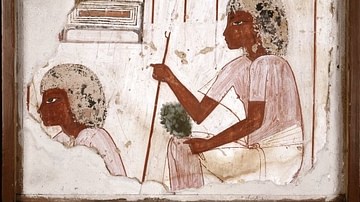
Immortality of Writers in Ancient Egypt
For the ancient Egyptians, life on earth was only one part of an eternal journey which continued after death. One's purpose in life was to live in balance with one's self, family, community, and the gods. Any...
