
Search
Remove Ads
Advertisement
Search Results

Definition
Kapilavastu
Kapilavastu (“Place of Kapila”) is the name of the city where Siddhartha Gautama (the Buddha, l. c. 563-483 BCE) grew up and lived for the first 29 years of his life before leaving to pursue the spiritual path which led to his enlightenment...

Definition
Ancient Scotland
Scotland is a country which, today, comprises the northern part of Great Britain and includes the islands known as the Hebrides and the Orkneys. The name derives from the Roman word "Scotti" which designated an Irish tribe who...
Definition
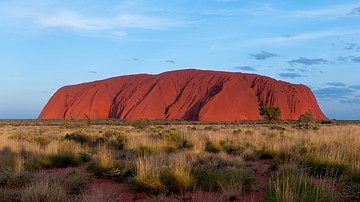
Uluru
Uluru (also known as Ayers Rock and pronounced: ool-or-roo) is a large natural sandstone rock formation located in the Northern Territory of Australia. It stands at a massive 348 meters tall and measures a lengthy 9.4 km in width. The...

Video
Ancient History of Winter Solstice Traditions and Sites
The winter solstice, falling in December in the Northern hemisphere and June in the Southern hemisphere, is the shortest day and longest night of the year. The winter solstice, also referred to...

Video
Native Tobacco - Traditional Uses of Tobacco as a Sacred Medicine
Tobacco is considered the most sacred of the Indigenous sacred medicines, used in virtually every ceremony as a means of connecting directly to the Creator. Native tobacco is used in ceremonies...

Article
Pilgrimage in the Byzantine Empire
Pilgrimage in the Byzantine Empire involved the Christian faithful travelling often huge distances to visit such holy sites as Jerusalem or to see in person relics of holy figures and miraculous icons on show from...

Video
Prehistoric Rock Art Sites in the Côa Valley and Siega ... (UNESCO/NHK)
The two Prehistoric Rock Art Sites in the Côa Valley (Portugal) and Siega Verde (Spain) are located on the banks of the rivers Agueda and Côa, tributaries of the river Douro, documenting...

Video
Gebel Barkal and the Sites of the Napatan Region (UNESCO/NHK)
These five archaeological sites, stretching over more than 60 km in the Nile valley, are testimony to the Napatan (900 to 270 BC) and Meroitic (270 BC to 350 AD) cultures, of the second kingdom...

Video
Stonehenge, Avebury and Associated Sites (UNESCO/NHK)
Stonehenge and Avebury, in Wiltshire, are among the most famous groups of megaliths in the world. The two sanctuaries consist of circles of menhirs arranged in a pattern whose astronomical significance...

Video
Prehistoric Sites and Decorated Caves of the Vézère Valley (UNESCO/NHK)
The Vézère valley in France contains 147 prehistoric sites dating from the Palaeolithic and 25 decorated caves. It is particularly interesting from an ethnological and anthropological...
