
Search
Remove Ads
Advertisement
Search Results

Definition
Andrea Palladio
Andrea Palladio (1508-1580 CE) was an Italian Renaissance architect most famous for the villas he designed in and around Vicenza and two large churches in Venice. Palladio blended elements of classical architecture, particularly...

Definition
Ovid
Publius Ovidius Naso, more commonly known to history as Ovid (43 BCE - 17 CE), was one of the most prolific writers of the early Roman Empire. His works of poetry, mostly written in the form of elegiac couplets, influenced many of the...

Definition
Ostia
Ostia (or Ostia Antica) lies 15 km from the city of Rome for which it served as the city's principal port and harbour throughout antiquity. The name derives from 'os' or 'ostium' which means 'mouth' and refers to the city's location at...

Definition
Cybele
History verifies the importance of religion not only on a society's development but also on its survival; in this respect the Romans were no different than other ancient civilizations. During the formative years of the Roman Republic...

Definition
Ptolemaic Dynasty
The Ptolemaic dynasty was a Macedonian royal family that ruled Ptolemaic Egypt from 323 to 30 BCE. It was founded by Ptolemy I, a general and successor of Alexander the Great. They built Alexandria, including the Lighthouse of...
Definition
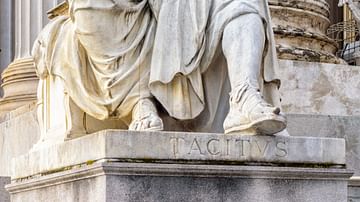
Tacitus
Publius Cornelius Tacitus (l. c. 56 - c. 118 CE) was a Roman historian, active throughout the reign of Trajan (r. 98-117 CE) and the early years of Hadrian (r. 117-138 CE). His best-known works are Histories and Annals, which cover the...

Definition
Pergamon
Pergamon (also Pergamum) was a major intellectual and cultural center in Mysia (northwest Asia Minor, modern-day Turkey) which flourished under the Attalid Dynasty (281-133 BCE) during the Hellenistic Period. It was the capital of the...

Definition
Constantine I
Constantine I, aka Constantine the Great, was Roman emperor from 306 to 337 CE. Realizing that the Roman Empire was too large for one man to adequately rule, Emperor Diocletian (284-305 CE) split the empire into two, creating a...

Definition
Roman Medicine
Roman medicine was greatly influenced by earlier Greek medicine and literature but would also make its own unique contribution to the history of medicine through the work of such famous experts as Galen and Celsus. Whilst there...

Image Gallery
History by the Numbers, Volume I - 12 Visual Stories of Power, Conflict, Discovery & Change
History is filled with numbers: years of rule, distances travelled, armies mobilized, cities besieged, territories conquered, and generations transformed. History by...
