
Search
Remove Ads
Advertisement
Search Results

Image
Royal Mausoleum of Mauretania, Algeria
The Royal Mausoleum of Mauretania near Tipasa in Algeria is a funerary monument built in 3 BCE by Juba II of Numidia (c. 50 BCE- c. 25 CE) and his wife Cleopatra Selene II (40 BCE-c. 5 BCE). This tomb may have...

Image
Royal Sceptre, Kingdom of Kongo
A gold sceptre used by the kings of the Kingdom of Kongo (14-19th century CE). 17th century CE (?). (Royal Museum of Central Africa, Brussels, Belgium)
Image
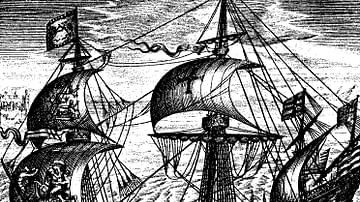
Ark Royal Warship
An illustration by Claes Jansz Visscher of the Ark Royal, an English galleon warship which fought in the Anglo-Spanish War during the Elizabethan period. (National Maritime Museum, London)

Image
Abbey of Port-Royal-des-Champs
An 18th-century painting of the Abbey of Port-Royal-des-Champs in France.

Image
Royal Lion Hunt on Chariot
Relief depicting a royal lion hunt on a chariot, Neo-Assyrian Empire, c. 645-635 BCE. The king (recognizable by his distinctive hat) rides around the arena on a chariot shooting lions with arrows. His attendants fend...

Image
Royal Portal Statues, Chartres Cathedral
A selection of statues that line the main triple entrance, the Royal Portal, of Chartres Cathedral, France. The statues depict a variety of professions, from kings to paupers. 1145-1155 CE.

Image
Evacuation of the Portuguese Royal Family to Brazil
The Portuguese royal family evacuates Lisbon for Brazil as the French army closes in at the start of the Peninsular War (1807-1814). Painting by Henri L'Evêque, 1812.
Image
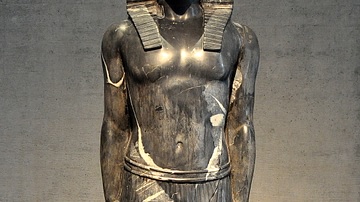
Egyptianized Royal Statue from Hadrian's Villa
This marble statue depicts a standing-striding royal man with an Egyptianized style and was found at Hadrian's villa (Tivoli), Italy. Roman period, circa 135 CE.(State Museum of Egyptian Art, Munich, Germany...

Image
King Louis XVI of France in Grand Royal Costume, 1779
Louis XVI, king of France and Navarre, wearing his grand royal costume in 1779, oil on canvas by Antoine-François Callet, 1789.
Palace of Versailles.

Image
Elizabethan Royal Navy
A 1907 CE painting showing ships of the English Royal Navy during the Elizabethan period (1558-1603 CE).
