
Search
Did you mean: Roman Art?
Remove Ads
Advertisement
Search Results

Image
The Five Good Emperors of the Roman Empire (96 - 180 CE)
This infographic illustrates the succession of Roman emperors from 96 to 180 CE, commonly referred to as the Five Good Emperors - Nerva, Trajan, Hadrian, Antoninus Pius, and Marcus Aurelius. This...

Video
The Roman Epic Poem The Aeneid: Introduction and Summary
The Aeneid was written by the Roman poet Virgil who lived between 70 and 19 BCE during the Augustan Period (named for Augustus, the first emperor of Rome). The twelve-book long epic poem tells the...
Definition
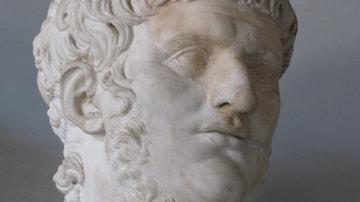
Nero - The Artist Emperor
Nero (37-68 CE) was the fifth Roman emperor, who reigned from 54 to 68 CE. The last emperor of the Julio-Claudian Dynasty, he came to power at the age of 16 with the help of his mother, Agrippina the Younger. Initially...

Definition
Plebeians
Plebeians were members of the plebs, the hereditary social class of commoners in ancient Rome. Their exclusion from political power by the patricians, who claimed to be the descendants of the first senators, led to Conflict of the...

Definition
Vestal Virgin
Vestal Virgins (Latin: Vestales) were the priestesses of the Roman goddess of the hearth, Vesta, in the state religion of ancient Rome. At varying times there were four to six priestesses employed. They were the only full-time clergy...

Definition
Legio II Augusta
Legio II Augusta was a legion of the Roman army that, throughout its centuries-long history, had fought in the Cantabrian Wars of 29-19 BCE, Germanicus' German campaigns in 9 CE, the invasion of Britain in 43 CE, and Septimus...

Definition
Trajan's Column
Trajan's column, erected in 113 CE, stands in Trajan's Forum in Rome and is a commemorative monument decorated with reliefs illustrating Roman emperor Trajan's two military campaigns in Dacia (modern Romania). The column was the...

Image
Roman Soldier Guards a Captured Gaul
This is a terracotta relief. Captured weapons and a cloak hang on a tree as a trophy (symbol of victory). The stamped inscription M(arcus) Anton(ius) Epaphra(s) refers to the workshop producing the plaque. Made...
Image
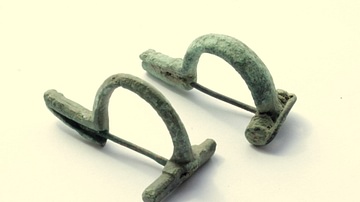
Roman Fibulae
Two P-shape bronze fibulae. 2nd-3rd century CE. Provenance unknown. (private collection)

Article
The Principate of Augustus
Augustus (r. 27 BCE to 14 CE), as the adopted son and heir of Julius Caesar (100-44 BCE), brought an end to the Roman Republic, and on 16 January 27 BCE, by Senatorial decree, he became the first Roman emperor. However...
