
Search
Remove Ads
Advertisement
Search Results

Definition
Mystery Cults
Mystery cults, or mystery religions, were ancient religious associations characterized by secrecy and initiation rites. They typically surrounded one primary deity, but some mystery cults venerated multiple deities in their rites. Members...

Article
Color in Ancient Egypt
The ancient Egyptians had a great appreciation for life which is clearly depicted through their art. Images of people enjoying themselves - whether in this life or the next - are as plentiful as those most often seen of the gods or funerary...

Definition
The Ankh
The Ankh is one of the most recognizable symbols from ancient Egypt, known as "the key of life" or "cross of life" and dated to the Early Dynastic Period (c. 3150 - 2613 BCE). It is a cross with a loop at the top sometimes ornamented with...

Definition
Osiris
Osiris is the Egyptian Lord of the Underworld and Judge of the Dead, brother-husband to Isis, and one of the most important gods of ancient Egypt. The name `Osiris' is the Latinized form of the Egyptian Usir which is interpreted as 'powerful'...

Definition
Pharisees
The Pharisees were a Jewish sect that emerged c. 150 BCE and promoted the idea of priestly purity for all Jews, belief in providence or fate, and the concept of the resurrection of the dead, and taught that besides the commandments, Oral...
Definition
Zagreus
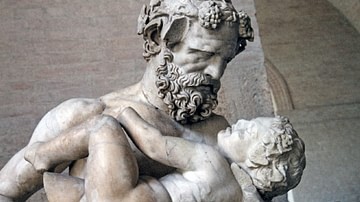
In ancient Greek mythology, Zagreus is a god closely associated with the wine god Dionysus, the underworld, and hunting. A son of Zeus and Persephone, he is known in the Orphic tradition as the first incarnation of Dionysus, whilst other...

Definition
Piero della Francesca
Piero della Francesca (c. 1420-1492 CE) was an Italian Renaissance artist whose paintings and frescoes are characterised by their solid figures, bright colours, and harmonious composition. His masterpieces include the painted panel the Flagellation...

Article
Mummification in Ancient Egypt
The practice of mummifying the dead began in ancient Egypt c. 3500 BCE. The English word mummy comes from the Latin mumia which is derived from the Persian mum meaning 'wax' and refers to an embalmed corpse which was wax-like. The idea of...

Article
The Separation of Christianity from Judaism
In the mid-2nd century CE, Christianity began a gradual process of identity-formation that would lead to the creation of a separate, independent religion from Judaism. Initially, Christians were one of many groups of Jews found throughout...
Article
Ancient Egyptian Symbols
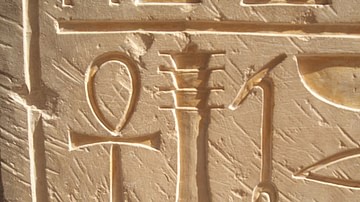
Religion in ancient Egypt was fully integrated into the people's daily lives. The gods were present at one's birth, throughout one's life, in the transition from earthly life to the eternal, and continued their care for the soul in the afterlife...
